Mickey Mouse is an cartoon character co-created in 1928 by Walt Disney and Ub Iwerks.





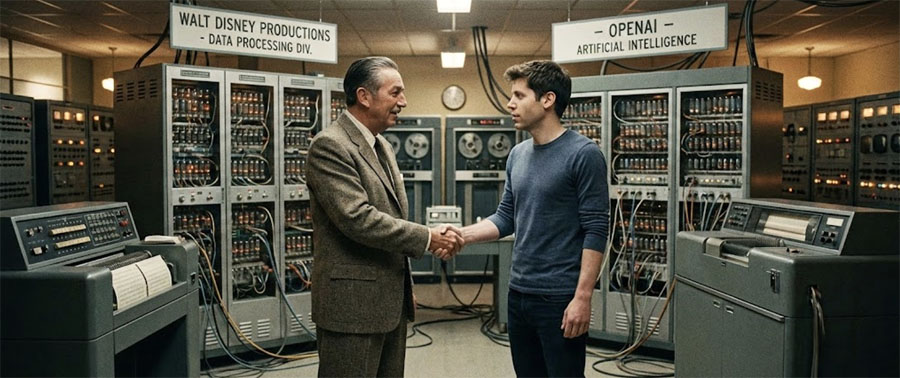
I’ve been working in the digital entertainment industry since the late 1990s. I’ve used Maya since its first version for theatrical and videogame character animation, modeling, texturing, rigging, VFX, and game programming. I now create AI-related content at a major tech company. I mention all of this as a way of conveying my familiarity with both the art side and the tech side of where we currently find ourselves. When I heard about the Disney and OpenAI deal, I was not worried, not angry, but excited. I totally understand the sentiment that I have seen online in reaction to this partnership. I thought I’d write a bit about it and where I’m coming from in my enthusiasm for the deal.
What the deal really is
Disney and OpenAI announced a three-year licensing deal. It lets people using OpenAI’s short video tool, Sora, make short, fan-made social videos using a set of Disney characters and worlds. The deal covers more than 200 characters across Disney, Pixar, Marvel, and Star Wars. It also includes things like costumes, props, vehicles, and famous places. Disney+ will stream a curated selection of these fan-made shorts. Disney will also use OpenAI’s tools inside the company, including Disney+, and it will deploy ChatGPT for employees. Disney is also making a $1 billion equity investment in OpenAI. The deal does not include talent likenesses or voices.
This is something I believe Walt himself would have done
I have been reading post after post on Facebook, LinkedIn, and other social media where artists and creatives are very much against this deal. When I hear this, I think about all of the forward-looking initiatives Walt Disney embraced at a time when other people thought he was crazy. He did these things at a time when they were expensive, they looked risky, or the audience did not even fully know what they wanted yet. Time and time again it would prove to put him and his company far ahead of competitors and right where they needed to be. This deal continues that pattern.
Color when it was a gamble
In 1932, Disney made Flowers and Trees for the Silly Symphonies. It started as a black and white cartoon. Walt then made the decision to scrap it and remake it in color. It costs a lot of money to do something like that, and it is a big bet. He believed color would make the film better, and he pushed for it anyway. He also signed a deal with Technicolor that gave Disney a big head start for animated shorts.
Walt was not a person to play it safe. He was constantly setting the studio up for future success.
A studio built like a flexible industrial facility
When the Disney built their Hyperion location (or the “new studio” as Frank Thomas referred to it), Walt Disney intentionally designed the studio like a flexible industrial facility, not a precious “art building,” so it could be easily repurposed or sold if the animation business failed. One of the realistic buyers at the time was the hospital across the street, which heavily influenced how the building was planned. Walt had already gone bankrupt once, and he was planning for the future, just in case.
TV, even when TV could not show the best version yet
Walt also pushed color for television. For years, people had to watch Disney shows in black and white. Walt wanted color TV. In 1961, Walt Disney’s Wonderful World of Color debuted on NBC in full color.
Disney filmed many of those early TV shows in color even when it cost much more, and the networks could only broadcast in black and white. That way, Disney was ready when the world caught up. This is the same playbook we are seeing now.
Animatronics: turning “impossible” into a repeatable show
Have you been to Disneyland or Disneyworld? Audio Animatronics did not just happen. Walt obsessed over movement. He studied simple toys. He pushed teams to make figures talk and act. The early work led to shows like the Enchanted Tiki Room, and later bigger human figures like Lincoln (and now Walt himself). It took vision, time, and patience, and it helped turn theme parks into a new kind of storytelling stage. Costumed characters didn’t go away. This was a way to get repeatable, consistent performances for the public.
When I look at Disney teaming with OpenAI, I don’t see a break from Disney history. I see a straight line.
The real goal: reach the next generation where they live
Take an honest look at where we are in late 2025. A lot of kids do not “go looking for a movie” first. They find a character in a 10-second clip on Tik Tok, Instagram, YouTube, etc. They may see a funny moment. A cute reaction. A remix. A meme. A short that gets shared in a group chat. That is how the TikTok generation discovers things. It’s fast, social, and made to be passed along.
Disney knows this. Disney wants lifelong fans. The kind who may start with a clip, but then end up with decades of love. Love for Disney movies, shows, games, toys, and parks. That is not evil. That is the whole point of a storytelling brand that wants to last. This deal is built for that world.
Sora is aimed at short, shareable videos. Disney+ becomes a “best-of” stage for the strongest fan shorts. And the deal includes a stated focus on safety and creator rights. I am sure there will be tight guardrails on what can be created and how the characters can be used. This is not just about making content faster. Not at this stage anyway. It is about making engagement easier. That matters because engagement is the new front door. It’s how you reach new fans and find the audience where they are, on their phones.
As an animator, here’s what I like about it
When I animated for films, I learned that you spend a lot of time getting your performance the way you (and more importantly the director) wants it. Animators often film reference for their shots, painstakingly filming and comparing their animated performance to the reference to find the best performance for the moment. A blink, a head tilt, a sigh. That work is real, it is hard, and it is worth protecting.
I also know something else is true. Most people are not trying to make a feature film. They want to make a birthday greeting, a silly motivational video for a friend in the hospital, or a clip that fits the day they are having. This kind of creation has always existed. People want to make something that feels personal. I have filled countless sketchbooks with Donald Duck, created posters of characters for friends, and made flipbooks out of the corners of my math books (some of my best drawings came from my math class).
This deal is Disney saying: “We see you. And we’d rather you create with permission and guardrails than in a gray zone.” That is healthy.
This deal creates a new kind of creative ladder:
That is how you build a lifetime relationship with a brand.
“This is going to be AI slop!”
Quality is a fair worry. AI tools can produce junk, and there is a lot of AI slop out there. I did some tests on my own on mass-producing YouTube videos using ChatGPT and various other APIs last year over holiday break just to see how the process worked. The results were what everyone would call AI slop. Disney cannot afford to turn its characters into noise. That is why curation matters. This deal is not to create slop.
Disney said it will stream a selection of fan-inspired shorts on Disney+. This implies a filter and some kind of curation. It is currently much too easy to find videos online of Disney characters like Elsa or Judy Hopps doing all kinds of non-Disney things.
This deal will give the public a central, curated location for officially authorized shorts.
Disney and OpenAI will have many issues to address for a successful system. The press release already mentions “responsible use”, “user safety”, and “rights of creators”. I would imagine that the full version of this system on Disney+ may include some kind of “made with AI” label, strong age rules and safety checks, keep characters on-brand and on-model, and create a path for creators to be recognized (and maybe paid) when their work is featured.
“But what about artists?”
Regarding Disney’s studio use of AI, it should also invest in the humans who make Disney feel like Disney. This means things like new training and adjustments to content creation pipelines. This adoption of AI is a moment like the creation of the CAPS system or the shift to computer animation, but will happen much, much faster. The successful artist will be one that embraces the change and meets the challenges and complications of AI head on. Generative AI does not have to mean “press a button and draw Mickey for me”. That is an overly simplified view of AI. Yes, it can do that, but a truly successful system will have artists and engineers to guide it. AI when used correctly will amplify and expand the capabilities of an artist, allowing them to create more content and at a rate much faster than ever before.
One thing to remember is that it is “show business” and not “show art”.
AI will allow the studio to create content faster and cheaper. This is something they have always been trying to do. Concept artists could be using AI to create variations quickly, engineers could be using AI assisted coding to make tools quicker, animators could create alternate takes with ease. Artists need to do their part and embrace the change. Artists don’t help themselves by pretending AI isn’t coming or by actively working against it.
As impressive as it is, AI is just a tool. AI does not do layoffs. AI does not buy an animation studio just to close it and gain their intellectual property (rest in peace Blue Sky Studios). AI does not sexually harass interns or collude with other studios to keep salaries low. AI is only as good or bad as the people using it.
The Epic Games deal shows the bigger plan
This OpenAI deal is not happening in a vacuum. Disney has already made a major move into interactive, creator-led spaces with Epic Games. Disney and Epic are in a partnership to build a new games and entertainment universe connected to Fortnite. Disney invested $1.5 billion for an equity stake in Epic. The press releases for that deal talked about fans being able to play, watch, shop, engage, and create their own stories. That is the big idea. The Epic deal is about where people live with Disney stories in an always-on world. The OpenAI deal is about how people speak with Disney stories in short-form media.
Together, they are a clear push toward the future of fandom. People aren’t just watching passively anymore. They are participating in the worlds and stories they love.
Walt built rides. This builds a new kind of ride.
People sometimes forget how much of Disney’s history is built on tools. The multi-plane camera, color, sound, and the tech found in the parks were all new ways to move a crowd through a story. This deal feels like that.
It does not replace theatrical animation. It does not erase the need for artists who know acting and timing. If anything, it makes that knowledge more valuable, because the world will be flooded with “okay,” and everyone will crave “great.” Great still comes from people who understand story. That is what I learned on films and from talking to industry veterans, and this is what potential I see in AI tech. That is why I’m pro deal.
Walt was looking forward. He didn’t wait for the world to get comfortable. He helped pull the world toward the next thing.
Disney is doing that again, this time with AI.



2 Responses
The case laid out in this editorial is reasonable enough; I just feel it’s the best case scenario, and not a terribly likely one at that. Even if this accurately describes Disney’s intentions at the start of this process, there will always be tremendous pressure to use the technology more extensively to cut costs and speed up production, without consideration for preserving artistic integrity; in time, and despite whatever efforts the artists make to avoid it, Disney’s output will inevitably degrade, though not to the point of being just more AI slop.
You covered alot of bases in an elegant way that is uplifting and a little too nice nice. That said the ones who know what good ai can do, there are plenty examples now of Disneylike dreams capes that are better than 90% of Disney’s output. Which bodes well if the studio is as you say, betting for the right reasons. There is a world wide Creative Renaissance taking place that is taking visual and audio media into untold territories of wonder and imagination. So, let’s please create the answer to war and conflict, with media that uses the infinite imagination in beneficial and visionary ways teaching our young to develop themselves and their own creativity in the same way.