Mickey Mouse is an cartoon character co-created in 1928 by Walt Disney and Ub Iwerks.











In honor of Toy Story’s 30th anniversary and theatrical re-release on September 12, I spoke with five Pixar luminaries about their experiences making the first CG-animated feature and its continuing impact on the studio and the industry: Pete Docter (chief creative officer and three-time Oscar-winning director, who served as supervising animator), Bonnie Arnold (a producer, who later joined DreamWorks and oversaw the How to Train Your Dragon franchise), Bill Reeves (supervising technical director), Sharon Calahan (a technical director, before becoming director of photography on such films as the Oscar-winning Ratatouille), and Lee Unkrich (who served as editor before directing the Oscar-winning Toy Story 3 and Coco).
This article is divided into two parts: Docter, Arnold, and Reeves in part one and Calahan and Unkrich in part two.
Calahan on lighting the way forward for Andy and his toys
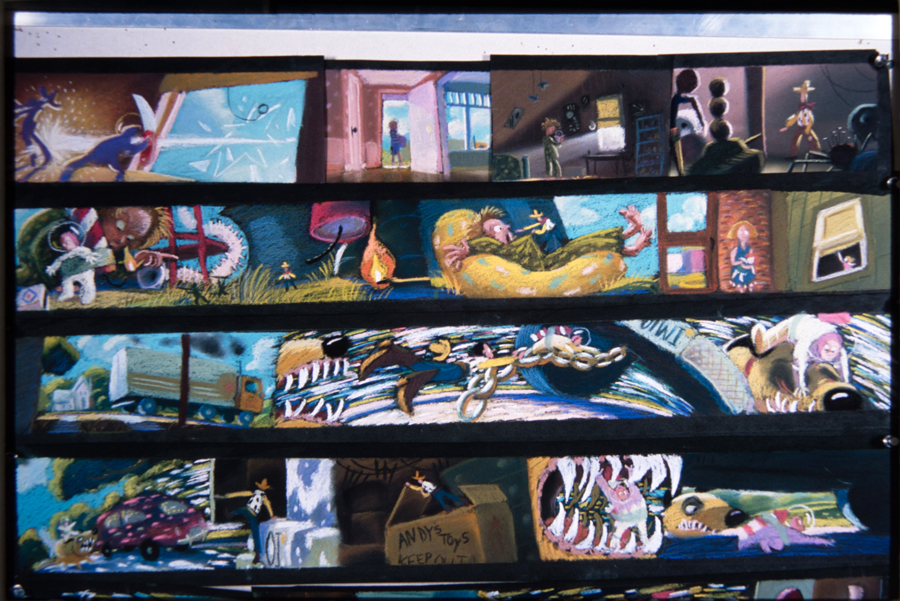
Cinematographer Calahan thrived on Toy Story, first as lighting TD and then as lighting supervisor. She worked with Eggleston on defining the color script and learning how to light many of the key moments. “We were just trying to figure out how to even make a film,” she said. “Ralph spent a lot of time thinking about the big picture stuff, and I was mostly trying to follow his lead and support him.”
The most important concept was making Andy’s world as open and bright as possible while lighting 15 characters in a shot, so there weren’t any shadows under his bed, or anything scary. That was dedicated to next door neighbor Sid’s ghoulish word, where the shadows went completely black under the bed. “John really wanted to make sure that everybody’s work was celebrated where he wanted to see everything well, especially in Andy’s room, with all the textures and careful modeling,” added Calahan.
“It was trying to get surfaces to look better as you were lighting,” she continued. “They did as much as they could when they’re shading, but you had to plus things with lighting, like getting the reflections on the floor to really look good, and the things that were supposed to be shiny to look shiny, and the things that weren’t to not look shiny. Back then, the way the render and shading world were set up, it was limited. You could only have around 12 lights. In the beginning, we didn’t even have a render farm. We were rendering the movie on our desktop computer. Trying to get Woody and Buzz’s faces to look well modeled and round with no weird shadows was a challenge.”
But the color variety and saturation in Andy’s room were impressive with a lot of orange and blue. As colored lights mixed together, though, they could be pleasing or ugly. “With the blues and the oranges, we had to push things so that they mixed to a nice purple and magenta color in the middle that looked nice on the characters,” Calahan said.
“One of the challenges in Andy’s room with it being so bright and the technology that we had at the time was to get the characters to have good ground contact with planting them with shadows and reflections so they didn’t look like they were floating,” Calahan recalled.
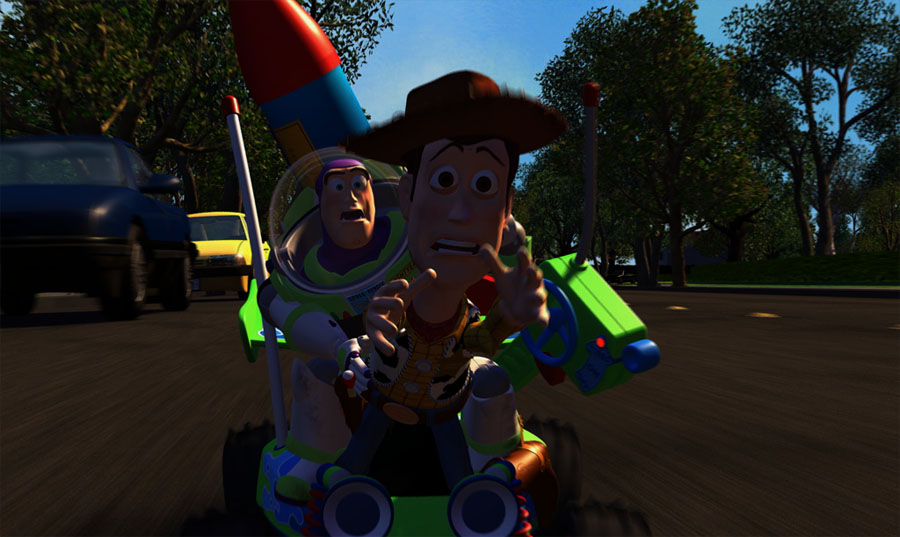
By contrast, Sid’s room had a lot of weird touches, such as glow-in-the-dark from the black light on his wall and the flashlight shining under his bed. “I ended up doing a lot of the lighting in that scene, and I put a lot of the stuff in, like the rain on the window that was very moody. I really like the rain patterns on Buzz’s face and on the desk when he’s strapped to the rocket. I like lighting things that tend to have more fun than just the material.”
Calahan experienced a range of emotions working on Toy Story. But she tried not to think about the enormity of the task. “It could be overwhelming, but we had no idea if anybody wanted to watch this,” she said. “We knew it was a good movie, but it was very gratifying that it did so well and people loved it and the whole industry was born.”
Unkrich on editing animation with cinematic style
Meanwhile, editor Unkrich was hired for a four-week stint to help finish Toy Story, mainly because he had previous experience cutting on the new digital Avid. He ended up staying at Pixar for 25 years. Now he’s back directing Coco 2.
“I remember having this feeling that there were scenes that were already cut that I wasn’t being asked to change at all,” said Unkrich, who split the editing with Robert Gordon (The Blue Lagoon). “Like early stuff in the room with the toys. And then there were new things coming in that were brand new sequences being boarded. And that was really what I was supposed to be cutting. And I remember this feeling of having to navigate what was sacrosanct and what wasn’t. I didn’t know anything about anything. I’d never worked in animation before.”
Yet Unkrich had a few ideas about improving what was already there. And, at some point, he tentatively started making changes and heard that it was okay. Then, during one story meeting, he nervously took the plunge and offered a more cinematic suggestion for when Buzz appears on the bed for the first time.
“The way it was boarded,” he said, “you see Woody climb up over the edge of the bed and then he sees something, and you cut and it’s Buzz’s feet and, from Woody’s POV, the camera rose up to find Buzz’s head.
“I totally took a chance and said, ‘You know what might be cool? What if Woody climbed up over the edge of the bed and looked up and then the camera pulled back and we actually pulled through Buzz’s legs and then rose up and found him? That’s, of course, what’s in the movie. And John said it was awesome and that was the beginning of him trusting me and I had ideas to bring to the table that were outside the realm of what an editor would normally be doing.”
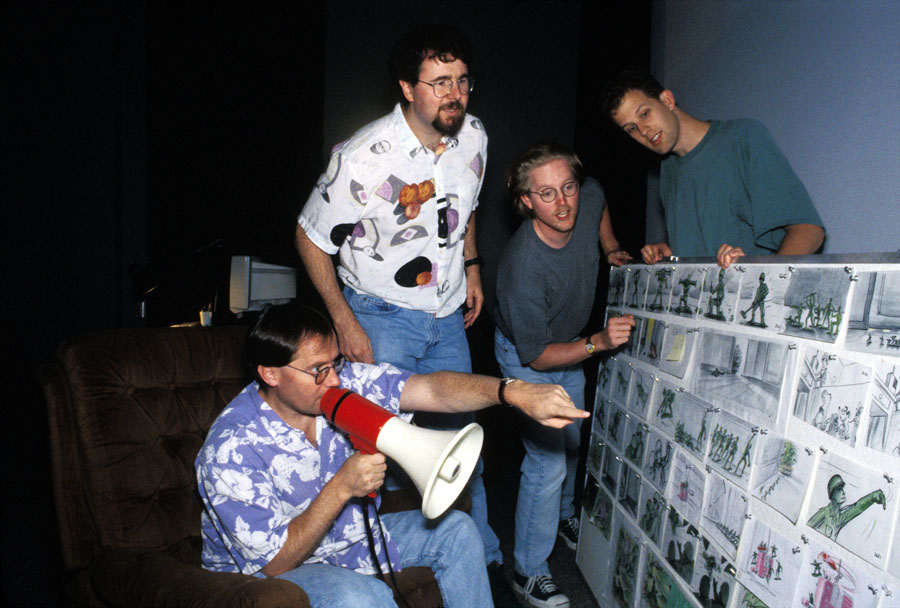
Looking back, Unkrich knew they were making something special and he was proud of the work. “Clearly, the story was good and it was well-structured,” he said. “At the time, the graphics were amazing to me. It was so cool every morning to be like the first person to see these scenes coming to life for the first time after being rendered the night before. Of course, we look back at Toy Story now and it’s completely janky and crude-looking in so many ways, and yet it’s watchable.
“Once you get over the hump of the awkwardness of the humans, and even the aliens are crude compared to where we got to later, you still get engaged in the story,” he continued. “Tom’s great, Tim’s great, all the performances are great. It moves, it’s well cut, it’s well staged, But it felt very strange to be up in Northern California in this little office park making what might be the first and last Pixar movie.”
Like everyone else, though, Unkrich was surprised by the critical and commercial success. But he knew they had gold with the match-lighting finale.“It was great when we started previewing the movie to hear whole audiences gasp when that happened,” he said. “I was really happy that that was a sequence that I got to cut. I prized my ownership over that, for sure.”
Toy Story obviously became a large part of Unkrich’s life. He co-directed Toy Story 2 with Lasseter and Ash Brannon, directed Toy Story 3 and executive produced Toy Story 4. And, if Stanton, needs him, Unkrich will be there. “We all trust each other,” Unkrich added. “Andrew has been so integral to [the writing] and nobody could ever write Woody better than Andrew. I found people often had a hard time finding the right voice for Woody in terms of his level of sarcasm and earnestness. And, for Andrew, it’s like it was in his blood to write for Woody.”