Mickey Mouse is an cartoon character co-created in 1928 by Walt Disney and Ub Iwerks.












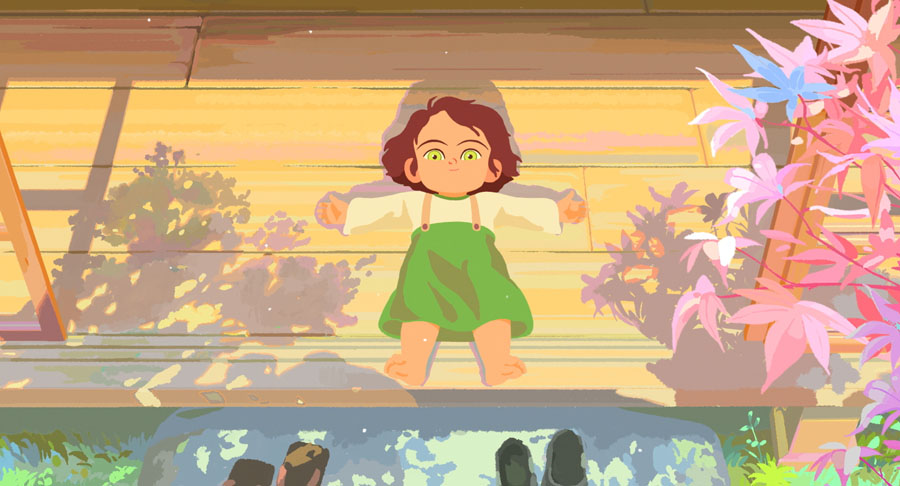
Little Amélie or the Character of Rain (GKids, opening October 31 in select theaters and wide November 7), won the Grand Jury Prize at the eighth Animation Is Film Festival in Hollywood for revealing “the world from the perspective of a toddler” filled with “the wonders and pains of being alive like poignant revelations.”
For first-time French co-directors Maïlys Vallade and Liane-Cho Han (Long Way North, The Little Prince), adapting the beloved autobiographical novel by Amélie Nothomb offered the opportunity to animate a dialogue-driven coming of age story with visual abandon. The titular young Belgian girl living in Japan in the early ’70s, expresses her atypical mind from birth to three and forms a bond with her Japanese housekeeper, Nishio-san, which shapes her identity.
“I loved the philosophical depth of this tale of early childhood,” Vallade said at Animation Is Film via a translator. “Also the confrontation of cultures between Japan and Belgium. For me, I really like to work on what is the foundation of people, how we build identity since childhood. This journey where you have this young girl who believes she is the center of the universe and this disillusionment where she realizes that nothing is the way you believe. She’s not the center of the universe, she’s actually part of it. I remember I cried when I read this moment in the book when she was really sad that [Nishio-san] wanted to leave. It was so emotional for me.”
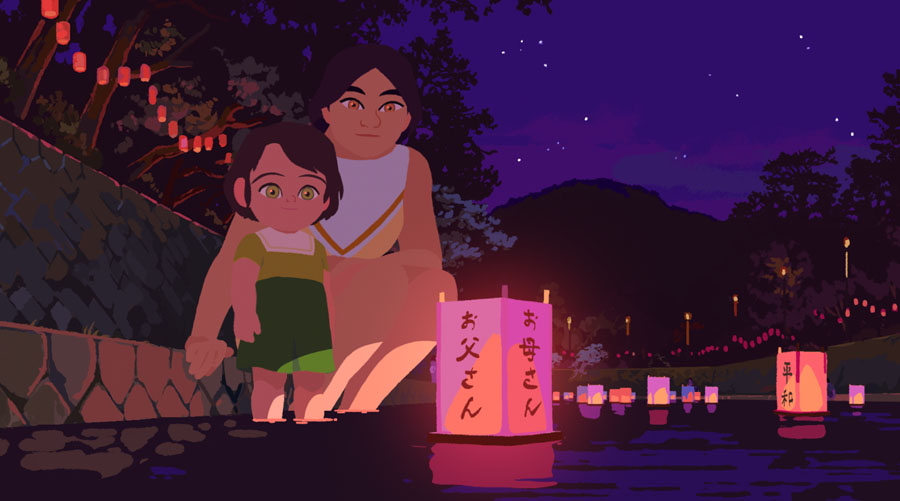
However, developing a new structure for this post-war setting in film was challenging. “We talk about grief and give some positive key to the audience of children and grown-ups,” Vallade continued. “It was really important for us to have these two layers of understanding. We love Japan, we are so inspired by Japanese animation, Japanese culture, so, of course, this was one of the great ingredients from the book.”
Aesthetically, the duo continued experimenting with the 2D graphic, gouache-inspired style without outlines that they began on Rémi Chayé’s Long Way North with art director Eddine Noël. But for Little Amélie, they wanted rounder shapes along with textured colors and pastel tones. They also played with blurring and transparency using a digital Adobe Animate pipeline at the 2 Minutes French animation studio.
“But in this movie, it was really great to push this idea of impressionist rendering to expose the euphoria of childhood and to balance the naive illustration with very deft thematics,” said Han through the interpreter. “The book is quite realistic. Honestly, it’s actually a book for adults. And our approach was to transcend this book. She’s walking on water, just like Jesus. But I thought maybe she should just open the water, too, like Moses. She sees the wonders of the world. But we’re in this period of post-World II Japan where the scars are still fresh.”
As we follow Amélie through the four seasons, framing and camera movement were patterened after live action. The lack of outlining also breaks the barrier between the character and the background. “We create more of a sensory experience with the light that goes through the characters, just like in reality,” added Vallade.
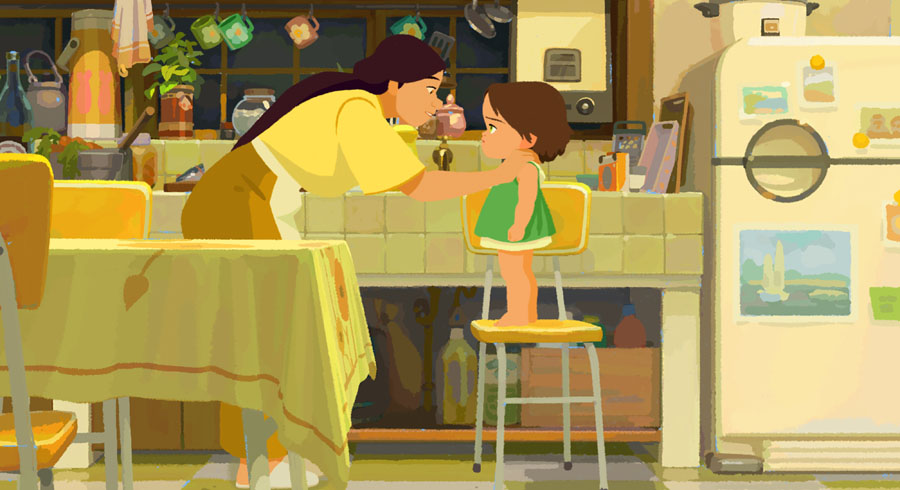
She pointed to the subdued light in the living room as its own character for when Nishio-san reads a scary book to Amélie. That’s when she imagines seeing the yōkai Otoroshi in the doorway and a single beam of light cuts across his silhouette. “So in this scene, the light symbolizes the sun that Nishio-san is for Amélie and we feel this direct connection between them.”
During a beach sequence without Nishio-san, Amélie experiences the sudden void between them. This is symbolized by an empty jar that she brings back to Nishio-san. When she opens it, Nishio-san experiences a phantasmagoria of memory.
“Nishio-san tells her you can go [to the beach], it’s okay,” Vallade explained. “You’re going to discover this place that is so special…that I’ve known when I was a little girl. And, at that moment, we had to find, just before Amélie’s fall, a way for their relationship to go even further, and for Amélie to offer something powerful to Nishio-san.
“When she’s on the beach,” Vallade contined, “she thinks about all of Nishio-san’s memories, as she’s dancing, and everything that Nishio-san told her. So she has this connection with Nishio-san, and Nishio-san has the power to see the inner wonder life of Amélie that she brings her back. These flashbacks, and the symbolic encounter between the two little girls is a big love from Amélie and a real soulmate relation with Nishio-san.”