Mickey Mouse is an cartoon character co-created in 1928 by Walt Disney and Ub Iwerks.







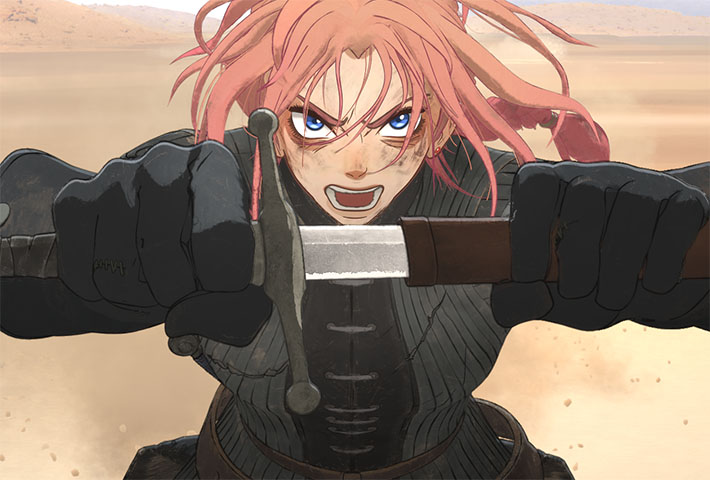
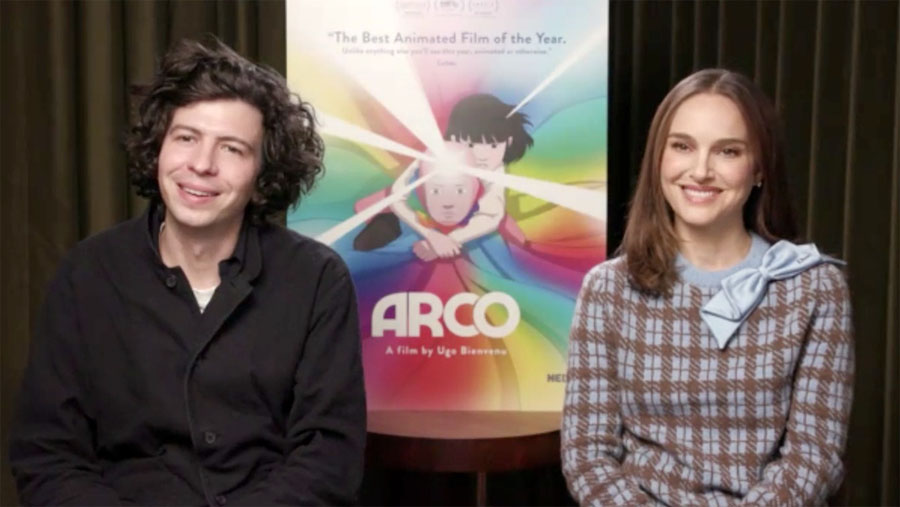
One of the most talked-about animated features of 2025 is Annecy winner Arco, a soaring and emotional fantasy adventure with a lot of grounded, contemporary, and very real themes. NEON is opening the film in select theaters in New York City and Los Angeles beginning this Friday Nov. 14 for a one-week, awards-qualifying run, ahead of a planned expansion soon. In this Animation Scoop Q&A, director Ugo Bienvenu and producer, actress and Academy Award winner Natalie Portman discuss the thrills and layers of Arco. (This interview was edited for length and clarity.)
Jackson Murphy: Congratulations on the movie. I saw it last month at the Woodstock Film Festival in upstate New York. It was part of opening night and the crowd loved it. Ugo, it’s an epic adventure about a special boy in the future [Arco], who travels back to 2075 and meets this special girl [Iris]. And what’s really strong about the movie is this connection between the two of them. What was so important to you about showing this connection?
Ugo Bienvenu: It was important to me to say that humans have the same feelings, share the same words, and share the same emotions. And even if we come from different eras, even if we come from different places, we still have this in common and we’re all made of the same wood, you know?
JM: Yeah. It’s a powerful film. And Natalie, what do you love the most about animated movies and what kind of qualities about animated films did you see in “Arco” to make you want to attach yourself to this project?
Natalie Portman: There’s so much I love in animation. I think one thing is that anything is possible. You’re not constrained by what you can build or film, or realistically show. You have a great artist like Ugo. They can create anything. And then also just the actual art of it. To see the hand-drawn nature of what Ugo does is extraordinary. You’re watching gorgeous art the whole time you’re watching this emotional journey. You’re also having an aesthetic journey. It’s rare to see art as beautiful as Ugo’s in animation, but it’s one of the things that I think Sophie [Mas], my producing partner and I were blown away by when we were first introduced to his work.
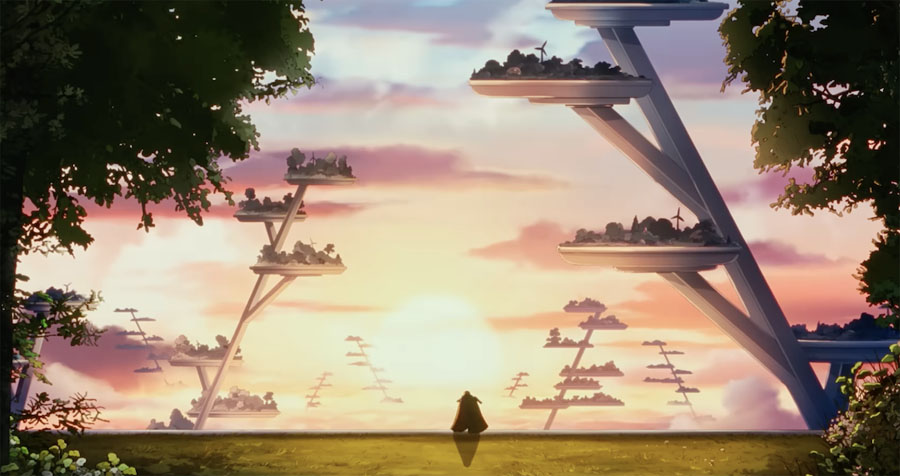
JM: Yeah, it’s a really nice looking film, and there’s so many fascinating elements, Ugo, of what a neighborhood looks like and what you show this neighborhood can look like. Can you talk a little bit about the houses and the domes and how you wanted to show all that?
UB: I’ve been really impacted, like I think the rest of the world in the ’90s, by the overall aesthetic of American neighborhoods. American self-culture is really strong. I always try to use our human unconscious, and I wanted the movie to feel comfortable. And comfort has been told also a lot by America to the world. This neighborhood is the idea of comfort, but also I always try to see what’s behind things and what hides the idea of comfort too. So it’s a mix of everything.
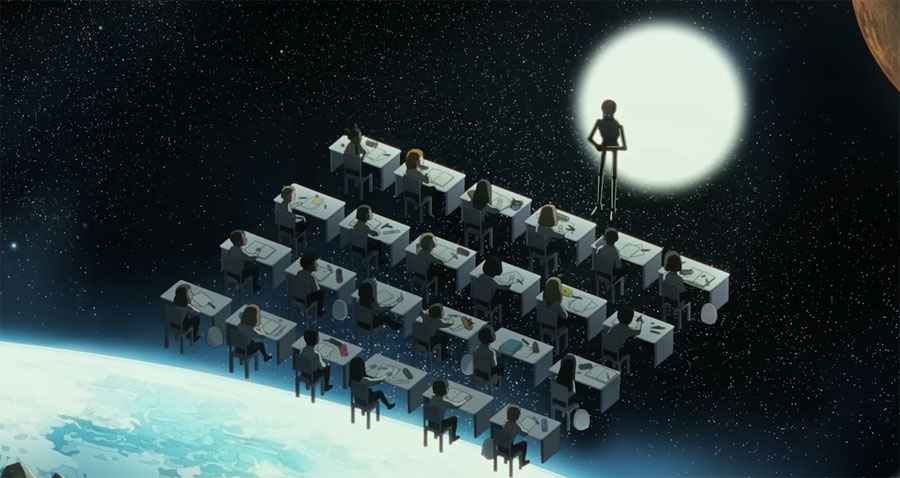
JM: And Natalie, the film has a lot to say about weather, nature, the environment and going into the classrooms — and the unique way we see the classrooms come to life. What do you love about the directions taken when it comes to all of that, especially showcasing this to families who are gonna go see this?
NP: Well, I think that there’s so many extraordinary worlds that you get to see. You get a few different versions of what the future could look like. I also think that what Ugo has created is such a… vision of the future that acknowledges the challenges we face as a human society, but without being pessimistic. It’s not foolishly optimistic, but it does trust in the power of human imagination and creativity to be able to face the challenges with ingenuity.
JM: Oh yeah. The power of creativity and thought really comes into play in the final scene as well, which we’re not gonna spoil, but it’s really well done. Ugo, [it’s] it in the poster behind you, the power of the rainbow as a symbol. What does that mean to you — showcasing that visually and also thematically in this story?
UB: Since the very beginning of humanity, rainbows are the symbol of the link for what’s bigger than us. And also it’s a symbol of hope. It’s a symbol of the end of the rain. And it’s a really, really interesting moment because when there are rainbows, it’s raining and sunny at the same time. And making the movie… we were always thinking about it, “Okay, let’s try to do a movie where emotions are always mixed,” in which you’re happy and sometimes sad at the same time. And to me it’s even more obvious in songs, but to me, the songs that are the best are the ones where I don’t know. When I’m happy, they make me happier. And when I’m sad, they make me sadder, in a way. But they are the same songs and they’re a mix of emotions. That was also the project too. I wanted the movie to be a mix of all this. And to me, making our job… making fiction is preparing the muscle of emotion for the audience. For us, this is the role of fiction in humanity. And it has to look at reality in the eyes and say, “Okay, this is the world we live in. This is what we’re gonna face.” But you’ll be prepared because you’ve done it in a safe space.
JM: Yeah, absolutely. And Natalie, the screening at Woodstock was the English version, so I got to hear your voice as Iris’ mom. And you’ve done some voice work recently as well in “The Twits” — and some narration, like in “Dolphin Reef”, which was very nice. So what do you love about going into the booth and delivering this voice performance?
NP: I love being able to do my work in sweatpants and no hair and makeup. (laughs) That’s a big joy as an actress, to be valued for what you have to bring and not what’s on the outside. And then it’s just a very lucky adventure to be able to participate with great artists, like Ugo, and like Phil [Johnston] who made “The Twits”, to get to be able to be part of it. And then to create something that I can share with my kids, which is so extraordinary… ’cause I’ve never really gotten to show my kids any of my films. I think them seeing me as another character… ’cause I’ve tried with some of the age appropriate ones. And… they don’t really want to, I think, see me, but somehow with an animation, they can watch it and it doesn’t disturb them. They just can get lost in the movie.
JM: I think kids are really gonna respond to this. Ugo, congratulations on winning the Cristal Award for Best Feature Film at Annecy earlier this year. What does that honor mean to you?
UB: It’s my profession. It’s the people I work with. We are always afraid to not convince and not make our profession happy. It’s like if you’re telling me, “Okay, you did a good job.” That’s what I’m trying to do. So I was happy that they told me. Really moving because there was almost the whole team in the room. A big part of it. And it was super moving to see them in the general audience. They watched the audience having the feelings that we wanted the audience to have. They saw all that work… this five years’ work… was relevant in a way and we didn’t lose our time doing it.
JM: Oh yeah, you made a film that’s gonna have a huge impact. Natalie, having NEON as the distributor of this… They put out “Flee”, which is so powerful as well [and] “Robot Dreams”, which I love. How does it feel having NEON get this movie out there [with] the qualifying run this week and then out to the world very soon?
NP: It’s been extraordinary to have NEON release the film. They have such incredible taste, so it’s an amazing kind of mark to have on the film. All the movies they put out are so wonderful, and also they really understand animation as an art form and how important it is in the world of film and that it’s a major part of cinema. So I think it’s really lucky to have them releasing the film and marketing the film.