Mickey Mouse is an cartoon character co-created in 1928 by Walt Disney and Ub Iwerks.













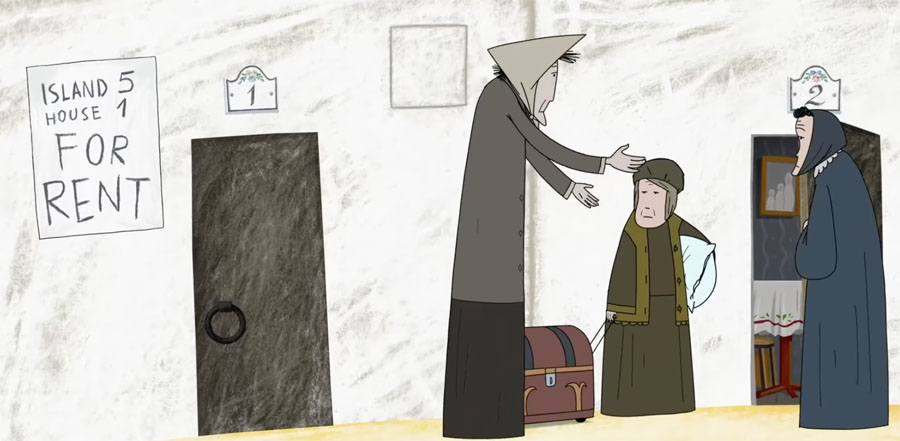
Talented director Konstantin Bronzit has received this third Academy Award nomination in the Best Animated Short Film category for comedy The Three Sisters. In this Animation Scoop Q&A, Bronzit (of Lavatory – Lovestory and We Can’t Talk About Cosmos) describes all aspects of making The Three Sisters and how he would feel about winning an Oscar on March 15th. (This Interview was conducted as an Email Q&A and was edited for length and clarity.)
Jackson Murphy: What inspired you to create this story of three women living on an island seeking the affection of a man?
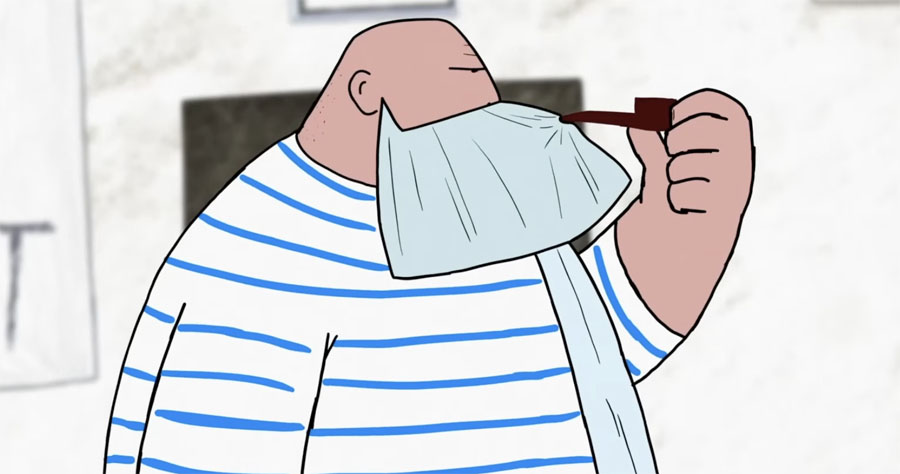
Konstantin Bronzit: I won’t surprise anyone by saying that since the time of the ancient Greeks, all world art has revolved around the human being, because, unlike animals, humans have passions that they can sometimes even control. An animal overwhelmed by emotions does not hide anything and reacts instantly – its reactions are instinctive. The range of human reactions to the surrounding reality, however, is almost limitless. A person, for example, can simply stand and calmly look at someone else, while at that very moment fires of love or hate may be raging within them. And this is where the director comes in – the one who invents a way to reveal this storm of passions to the viewer. The director creates the story and the context. That is why the human being has always been the focus of attention for artists, writers, playwrights, and even composers. It gives any artist almost limitless opportunities for creativity. Somewhere along the way, I came across a phrase by the famous director John Cassavetes: “Life is about men and women.” And I really liked it. But I would add that art is also about men and women – especially cinema. Because it is here that the most interesting twists and turns arise, and passions flare up with an unpredictable ending. That is why, when my friend Dmitry Vysotsky told me the idea of the film in a nutshell, it immediately hooked me and did not let go until it turned into a finished film. But the very end of your question makes me add something else. If we look closely at what happens in the film, we will see that the women’s goal is not even the sailor who suddenly appears on their island. He becomes an occasion for them to prove to each other that one is better than the other. It is a rivalry of ambition and vanity that had long been dormant within them – and which the sailor awakened simply by his appearance. That was their temptation.
JM: What was most important to you about the rhythm of the short — including the music and the timing of events happening in threes? In other words, what were your goals with the music and pacing of the short? I enjoyed how when one sister did something, the other two had to do it as well (like them dressing up in the colorful outfits).
KB: It’s no secret that the number three has its own kind of magic. Two is not enough, but four already feels like too much. This sense of a trio – almost like a rhythm – has been playing in my head from the very beginning. When I have an idea, this is usually how it works for me: for a long time I can’t think of anything concrete, the idea doesn’t unfold into a script. But once the first scenes start to appear in my mind, once I begin to see a clear sequence of actions, the process suddenly accelerates. Well-formed actions have their own inner logic, and that logic tells me where and how to move next. In this film, I immediately wanted to play with contrast – between slightly gloomy, almost contemplative music and the funny twists and turns that happen to the heroines. I had never done this before, and I really enjoyed playing with it. As a result, the viewer gets a little disoriented, not fully understanding where the director is leading them, or at what point the film shifts between genres. And this, for me, is also part of the magic of the number three – it catches your eye from the very first moment, starting with the title appearing on the screen. Three houses. Three doors. And then three men at the end. In a way, I completely hypnotized myself with this structure.
JM: Did you always know you wanted “The Three Sisters” to be primarily set over the course of a week, and were there any challenges with that?
KB: No, when I started inventing the first scenes, I didn’t think about dividing the action by days of the week at all. But as soon as I realized, already in one of the early episodes, that the audience needed a clear indication that a new day had begun – and that each new day would bring different events – I understood that this could be a good compositional solution. When I say “good,” I don’t mean that I’m certain everything was done perfectly, because there will inevitably be viewers and critics who disagree. I’m simply saying that at the time it felt right to me. When I was working on the animatic, someone from our small team noticed that a mistake had slipped into this structure: the days of the week didn’t quite align with the changes of day and night. In fact, the morning scene with the sailor and the tallest of the sisters was not marked by a day of the week, even though they had been absent all night. Fortunately, this was easy to fix. It’s always valuable to have someone look at your work with fresh eyes. There is also an important moment at the end, when, unexpectedly for the viewer, we switch from days of the week to the names of the months. This very simply shows the amount of time that has passed and, more importantly, transforms the intonation of the narrative – musically speaking – into a different register. At least, that’s how it feels to me. In general, this kind of game is built on very fine lines.
JM: The animation is bright and colorful. What were your goals with the look of the film?
KB: You’re asking about things that are difficult to explain. The creative process is irrational. Try suddenly asking a painter why, for example, he put a brushstroke in the green foliage in red rather than green. He won’t really be able to answer – or perhaps his answer won’t tell us very much anyway. When I was creating the film’s color palette for each scene together with the production designer, I was guided by one intuitive principle: that it would feel right for this film. It’s simply the way I “saw” this story with my inner eye. So the goal – if it can be put that way – was just one: the film had to look the way I imagined it in my head.
JM: They say comedy is more difficult than drama, especially for actors. You present comedy without any dialogue. How difficult is that?
KB: Everything is complicated. Creative life is never easy. It is designed in such a way that a person has to pay a high price for every creative act – sometimes a part of their life. I mean that every director struggles to make their films, regardless of the genre, and this is especially true in animation. I have always tried to balance my films around the funny. I learned this from Charlie Chaplin. My intuition led me to his films at a very early age. I immediately fell in love with them, and I know his work almost by heart. Today, Chaplin is hardly watched or studied. Young people may have heard his name, but they have not seen his films. And yet this is a true textbook of mastery: the language of pantomime, gesture, and physical action – which is the very foundation of animation. And also the way he knew how to pause, how to prepare a gag (because a gag must be prepared), and how to build the rhythmic curve of an entire film.
JM: Are you interested in revisiting these fun and lively characters again in a few years with a sequel short?
KB: You know, when I finished the film “We Can’t Live Without Cosmos” in 2014, I was absolutely sure that I would never return to space themes. If a fairy had appeared in front of me at that moment and told me that my next film would again be about an astronaut, I would have twirled my finger at my temple and said that this was impossible – because I don’t usually return to material I feel I have already explored. I love venturing into new territories. But something incredible happened: a few years later, I made the film “He Can’t Live Without Cosmos”. Of course, it was a completely different film – its main theme was fate and destiny – but once again, it was a story about an astronaut. After that experience, I stopped making promises to myself. I have no idea what might come into my head tomorrow. But one thing I know for sure is that I’m not going to sit down and deliberately invent a new story about the three sisters.
JM: What are your favorite memories of attending previous Oscars ceremonies, as a nominee for “Lavatory – Lovestory” and the iconic “We Can’t Live Without Cosmos”?
KB: Did you say iconic? This is actually the first time I’ve heard that. Michael Dudok de Wit’s film “Father and Daughter” – that is truly an iconic one. As for the two previous ceremonies, I have the warmest memories of them. Twice I had the chance to take part in the most important professional celebration on the planet, where the world honors its best filmmakers. I grew up almost on the other side of the globe, in a communal apartment – something like a large dormitory shared by many families – and in a rather poor household. Yes, since childhood I dreamed of becoming an animator, but even in my wildest dreams I could not imagine that one day I would stand next to great actors and directors whose films I had known since my youth. And now I can say that I have not only seen Spielberg and Stallone, but actually stood next to them. I sincerely wish every filmmaker could experience this feeling at least once. Personally, moments like these inspire me enormously. It’s as if a battery is being recharged.
JM: What would winning an Academy Award for “The Three Sisters” mean to you?
KB: I won’t say anything original here. In the world of cinema, the Oscar remains the most coveted award for almost everyone involved in this art. There is a single line in Andrei Tarkovsky’s diaries from which we learn that he, too, dreamed of an Oscar. For me personally, it would mean that, finally, from the point of view of the profession to which I have devoted my entire life, I have done something truly worthwhile. And that this was noticed not only by my closest relatives and school friends, who in fact don’t understand much about it, but also by professionals – by members of the Academy all over the world. Is it possible to dream of a better grade?