Mickey Mouse is an cartoon character co-created in 1928 by Walt Disney and Ub Iwerks.














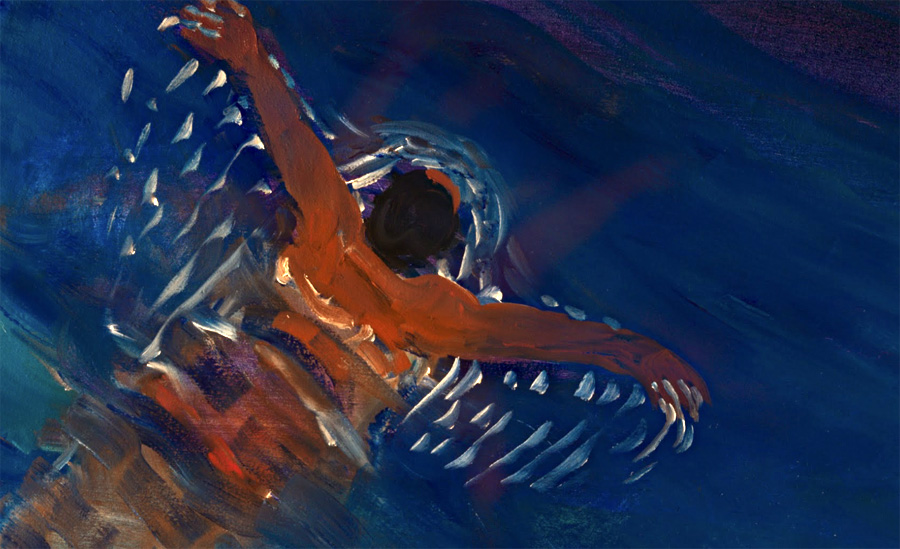
Director Florence Miailhe’s Butterfly (Papillon) is one of the 15 finalists for this year’s Best Animated Short Film Oscar. This Annecy-winning drama about Jewish French swimmer Alfred Nakache, who competed in the Olympics and was held captive at Auschwitz, is presented in painting-style animation. (This Animation Scoop Interview with Miailhe was conducted as an Email Q&A and was edited for length and clarity.)
Jackson Murphy: What interested you in diving into the story of a swimmer — and the inspiration of Alfred Nakache?
Florence Miailhe: Beyond Nakache’s extraordinary life story, working with the aquatic element felt like an exciting challenge, especially for creating a painted animated film. I believe my first motivation was to tell this story which, when I discovered it, deeply moved me and struck me as beautiful and emotional. It brought together many themes I wanted to address. I felt it was important, in today’s context, to recall elements of History. There are always artists and athletes who, regardless of their achievements, are excluded or discriminated against because of their skin color, nationality, gender, or sexual orientation—and they are only the visible part of a broader rise in racism, antisemitism, and homophobia. We are living in a period of border closures and hardened identities, with a global threat to fundamental freedoms and civil rights. Nakache’s story is also one of the deprivation of rights in the context of the rise of fascism in Europe. Algerian Jews had obtained French nationality through the Crémieux Decree (1870), but under the Vichy regime, Nakache was excluded from French competitions: he was no longer considered a French citizen. This decision also led to the arrest of his family and the death of his wife and daughter in the Nazi concentration camp of Auschwitz. Today, we once again hear about denaturalization, loss of nationality, expulsions, even deportations, and it is essential to remember how deeply an authoritarian power can impose decisions with tragic consequences for individuals.
JM: How did you want to structure the story involving the different time periods of his life?
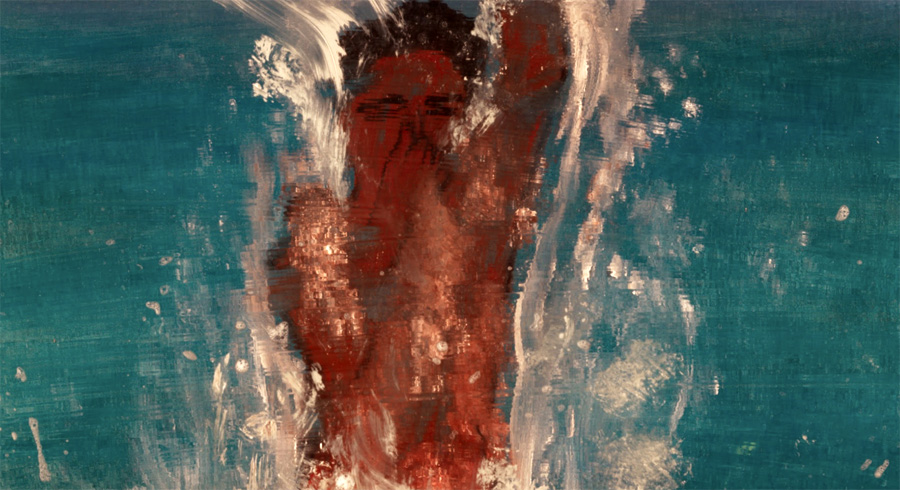
FM: I wanted to tell the story through Nakache’s final swim. Even though he knew he had a heart condition, Nakache swam one or two kilometers every day. He died in the Mediterranean Sea, on the border between France and Spain, during this daily exercise. I imagined this last crossing as a moment when memories from his life rise to the surface. All his memories are connected to water, which serves as a passage between the different ages of his life. These back-and-forth movements are created through transitions that, I believe, only animation can achieve. Nakache immerses his head in the water as an old man, and in just a few images, he becomes young again, discovering the woman who would become his wife.
JM: What were your goals with presenting the tone of the short?
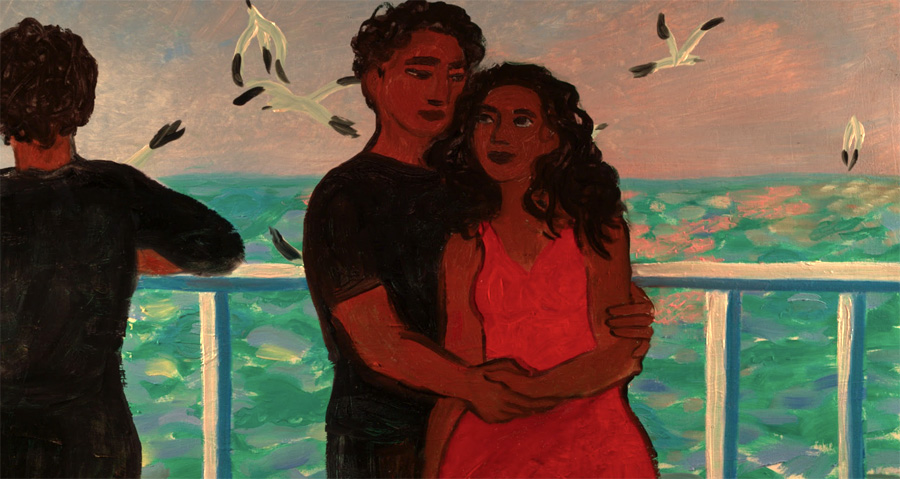
FM: I wanted to tell Nakache’s destiny like a fairy tale—the story of a man who, throughout his life, had a unique relationship with water. Water, in its many forms, is almost a character in the film. The film is not a documentary, and it was important to me that it had a poetic and metaphorical dimension. Not everything is said, but the essence of his life is told. It is a story of memories, which is why there is no voice-over and very little explanation. Only images and sounds return to his memory, evoking the most significant episodes of his life, from childhood to death. To achieve this, I made extensive use of painted animation and the possibilities it offers for transforming matter and shapes.
JM: The painting-like animation is fantastic. How difficult is it to make water move with this style of animation?
FM: I have worked with this animation technique all my life. The different phases of movement are painted directly under the camera. It is quite a difficult technique, but it allows for great fluidity in the sequencing of movements and shots. I have made several short films and one feature film, and I think that in almost all of them there is a presence of water. For “Butterfly”, I drew on the experiences from my previous films. In this film, I wanted to play with the different symbolic meanings of water: the clear water of rivers and childhood, the water of swimming pools and adulthood, the sea, the water of the pools at Auschwitz. Each way of representing and animating it was different. We used two levels of animation. One was directly on sets painted on canvas, mainly used to paint bodies underwater, which were distorted, often by an animated oil layer on top. The other level was for bodies above water, painted on glass. Some shots were quite easy to achieve because the animated oil layer over the sets rendered the transparency of the water and its ripples very effectively. For the sea and the waves, we worked more with the materiality of paint and color mixing. We also projected and animated soap bubbles on the glass—a more risky and unpredictable technique, but one that produced beautiful results.
JM: What kind of research did you do on swimming techniques and movements to make these moments look and feel as authentic as possible?
FM: I learned to swim with Alfred Nakache’s younger brother, William, who at the time was an instructor at a swimming club in a seaside resort in the south of France. He was the one who taught me the butterfly stroke. In a way, I feel like I am swimming the butterfly that Alfred himself had taught his brother. I have always loved water, and my father, who was also a very strong swimmer, encouraged my sister and me to practice this sport. I was part of my high school swimming club and later joined a club called Les Mouettes de Paris, where I also practiced synchronized swimming. One of the animators was also an excellent swimmer. In the studio, we mimicked the movements of the butterfly stroke. We took some liberties with the historical reality of swimming techniques in Nakache’s time. In the 1930s, the butterfly stroke appeared as a variation of the breaststroke. In this so-called “butterfly-style breaststroke,” the arm recovery out of the water allowed swimmers to go faster in competitions. Nakache was among the first swimmers to practice and improve it, becoming one of its pioneers. Swimmers lifted their arms out of the water, but the leg movements were still those of the breaststroke. The style later evolved. We created a blend between the dolphin kick as practiced today and the butterfly stroke swum by Nakache and his contemporaries. We didn’t want to give up the undulating movement, which is more recent and so beautiful to watch.
JM: You’re a Caesar Awards winner. I recently spoke with Sylvain Chomet about “A Magnificent Life”. France is a true animation hub. What do you love about the representation of animation from French filmmakers?
FM: French animation evolved very quickly with Paul Grimault and the directors he trained, establishing an auteur-driven form of animation. It is incredibly rich. We can mention Jean-François Laguionie, Michel Ocelot, Sébastien Laudenbach, Jérémie Clapin, Benoît Chieux, among others. Thanks to the support of the CNC and the French funding system, we can make very handcrafted films, like my feature “The Crossing”, as well as films that are more industrial in approach but where directors remain authors before technicians. Productions are also open to the boldest proposals, both in form and in subject matter. Short films also serve as a “research laboratory” for young filmmakers, and there are many animation schools that help renew French talent.
JM: What would an Academy Award nomination for “Butterfly” mean to you?
FM: It would be a wonderful recognition of my journey. Painted animation is quite rare and requires a great deal of patience, so I would be delighted if the film were nominated. Nakache was somewhat forgotten for many years. Today, people are speaking about him much more, and if my film can contribute to this long-overdue and well-deserved recognition, I would be extremely proud.