Mickey Mouse is an cartoon character co-created in 1928 by Walt Disney and Ub Iwerks.









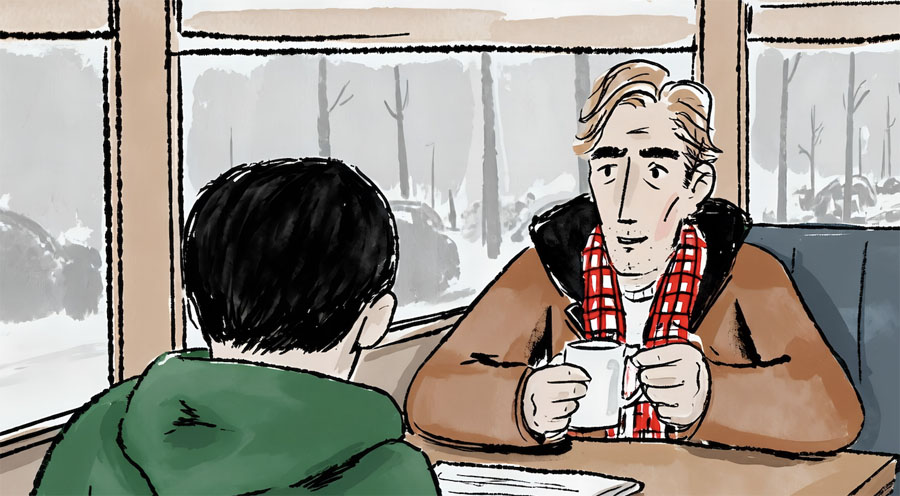
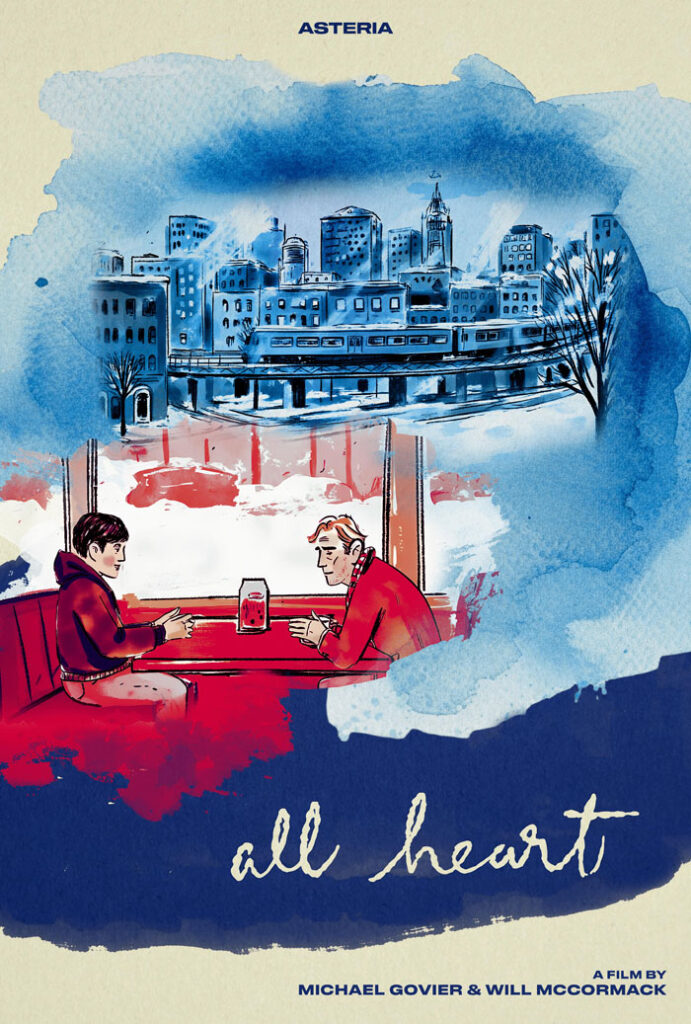
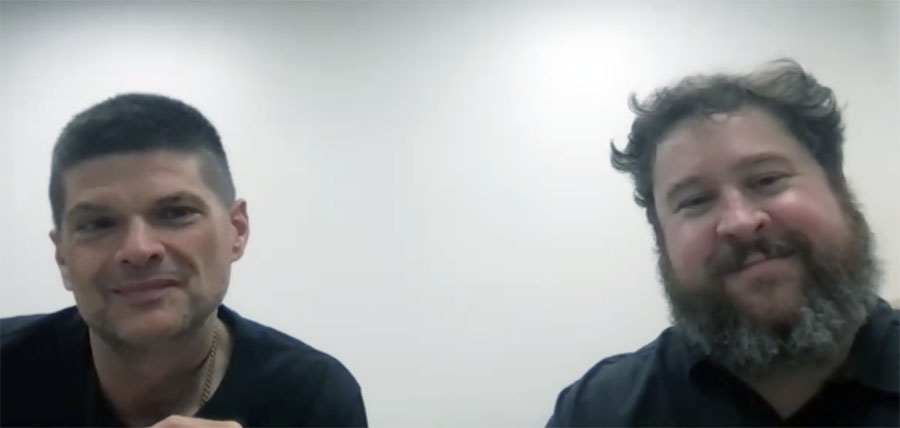
Michael Govier and Will McCormack won the Best Animated Short Film Academy Award in 2021 for If Anything Happens, I Love You. They’ve re-teamed to direct a new animated short, All Heart, which is vying for awards consideration this season. Govier and McCormack discuss this drama about a father in mourning and his emotional connection with a young man. (This Animation Scoop Q&A was edited for length and clarity. Images Courtesy: Asteria and Comet Films.)
Jackson Murphy: Michael, why did you guys decide now was the right time to team up on another animated short film — and with this story?
Michael Govier: We like to write about grief and discuss grief, and also we think animation’s such a wonderful way to build those discussions out. And this is our second film in what will be our trilogy and we’re calling it our Grief trilogy. So this is the second piece in that kind of larger thought and work. And we just always loved talking about grief and we talk about it in our own lives and what it means to me and us. And also we like grief being discussed in animation because we think it’s a great vehicle to start larger conversations.
JM: Yes. The look of this is powerful. The story is powerful. Will, going into this one, were there different ideas you had? A different approach versus last time making “If Anything Happens”? How did you wanna take on “All Heart” from a directorial standpoint?
Will McCormack: I think with both projects, we spent a lot of time on the script because we wanted to make sure we got it right and both films are so sensitive in the material. And we’re just finishing our third script for our animated short in this trilogy. We’re gonna start that in the new year. “If Anything Happens, I Love You” is really parsimonious and spare with color and it’s really simple. And this one just felt fuller and had more color. And both films are without dialogue, and so the music was so important to both because both films are so heavy in nature. I think a trap with the music is that it could sort of make it feel sullen or make it feel like it could drag behind. But the music was so important to bring the story forward and have buoyancy. So they’re different visually, but they feel like siblings creatively.
JM: You’re so right about the music. What Amanda Jones does is lovely. It’s layered. And Michael, I’m sure there were timing things that went into what parts of the music felt right at certain moments over the course of the short.
MG: 100%. Music, we always kind of felt that it was like the third character. It was a huge piece. We talked about music from the very beginning and as far as getting that flow, ’cause you don’t want it to be melancholy or maudlin or any kind of to pull you down. So we wanted to have buoyancy and have movement to it. So we listened to a lot of, as kind of like comps, Bill Evans. ‘Cause Bill Evans kind of has that buoyancy, but he has an underlying melancholy, but also there’s love and hope. And so, Amanda just knocked it out of the park with being able to hit all these layers and tones. And then of course, sinking it up beautifully with the film, as far as not pushing, not trying to say, “Hey, feel something now.” We just let the music be part of the scene.
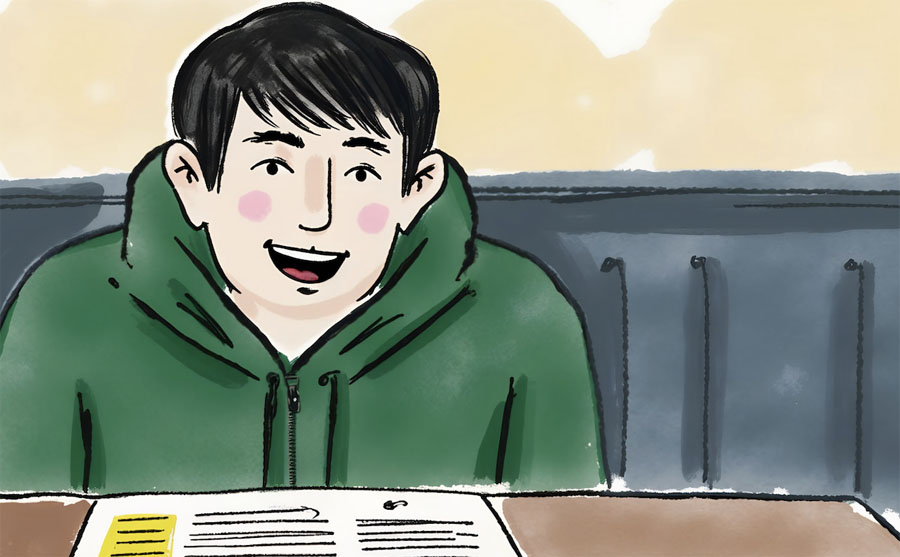
JM: Absolutely. And Will, as you mentioned, this has no dialogue, and so you have to make us connect to these characters without that, and you do a great job with that. And also the characters connecting to each other. We meet a man. He will meet a younger man at a diner for specific reasons. There are a few other characters and situations involved. How was that connection process? Was that a real challenge without having dialogue to make sure the connection works?
WM: I think it’s such a fun, creative challenge. Movies are moving images, and this story we thought that we could tell without any dialogue. And I think that there’s little Easter eggs along the way. If you go back and watch the film, there’s things that connect to each other. But for us… I’ve been a screenwriter for a long time. If I can tell a scene with as little dialogue as possible and make it feel really lean and parsimonious, that’s a great challenge. And with this, I think with Jimmy Thompson’s art and Amanda’s gorgeous music, it just didn’t need any. We’re open to it when we need it. And in fact, our third film in this trilogy, we’ll have dialogue and lots of it, but for “If Anything Happens, I Love You” and “All Heart”, it just felt like it didn’t need it. And we’re happy about that.
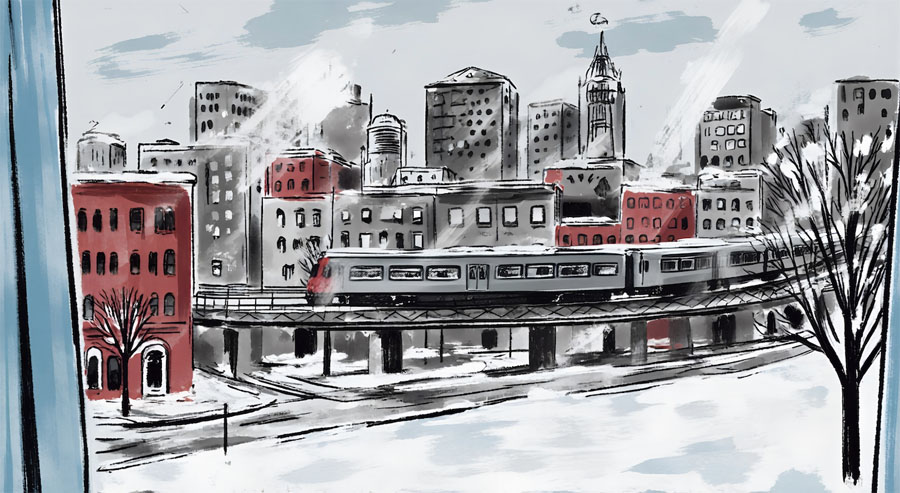
JM: And Michael, you create this winter atmosphere that I feel is so delicate and you’re immersed in it immediately. Can you talk a little bit about the winter atmosphere, making it feel so good?
MG: Yeah. We were so excited to have beautiful snow and it’s kind of set in Chicago and just that kind of feeling of what the city feels like, where it’s barren, it feels lonely and it feels hopeful. There’s all these things at the end of the year into winter. And I think we wanted just to show that, and also what life looks like in the winter. You gotta shovel out your car, you gotta shovel the sidewalk. You have to do practical things of what life looks like. And then also we just thought with Jimmy’s art, some of those paintings and the backgrounds are so gorgeous, you want ’em on your wall because it’s this beautiful snowscape. And so we were so excited to see that art kind of come to life.
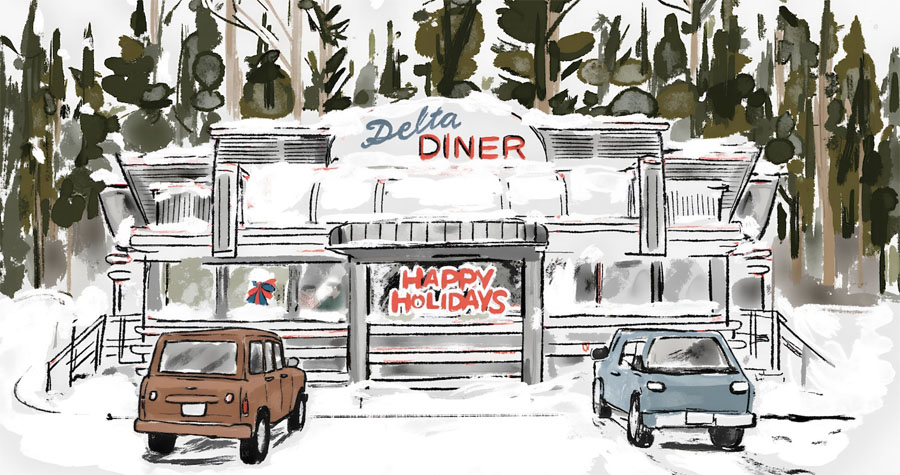
JM: Yeah, it really does. Will, there is also something about diners during the holidays. You see it in sitcoms, you see it in holiday movies, and the holiday episodes on shows. Going to a diner just feels right. Was there an emotional connection for you in wanting it to be a diner and setting this during the holidays and that match?
WM: Yeah. I’m from New Jersey, which is one of the diner capitals of the world. Greatest diners. And you know, every Christmas Eve, my dad and I used to go and get a Christmas tree and then with my sisters we would go and get blueberry pie after with vanilla ice cream at the Knotty Pine in Plainfield, New Jersey. But it’s just a place that feels so warm and inviting and it’s a place where community meets. And there’s something about it too that feels a little bit like a throwback. In L.A. we have “Art’s” and we have “Nate ‘n Al’s”, we have a few diners, but there’s something about it that just feels like community and it feels like a place where I think that these two people would meet up and have a conversation that’s hard, you know?
JM: Yes. It makes sense. It really works, and it’s a lot with the power of memories. Michael, what does that mean to you, the power of memory and having that be a core part of this?
MG: I think memory is so unique and we talk about it a lot as far as what memory is and how it feels, and also what you remember of someone. Do you actually remember the full scene? Do you remember everything in the background? Or do you remember this little specific moment with loved ones or just even what you did last week? There’s always this little moment, so we really were excited to show what memory looks like where you just have these little moments. And that you connect to and you’re like, “Oh, that’s right. That beautiful little thing. I remember that smile, that thing.” You’re not remembering it in full technicolor because… this little granular moment… that’s what you hung up on.
JM: There’s a lot with memories in this and an impact I think is gonna be had by so many. Already with big stars. One of your executive producers, Will, Natasha Lyonne, who was in three movies in a row this summer. It was “Smurfs”, then “Fantastic Four”, then “Bad Guys 2”. How is it having her as an executive producer, and with her voice acting and now involvement in this animated short, clearly she loves the medium of animation too.
WM: She loves it. We’re honored to have her. We’ve both been huge fans of Natasha’s work. She’s such a cinephile.Talking to her about films is just endlessly fascinating. She knows so much about movies. She’s so great in movies. She’s so great talking about movies, and she’s so great producing movies. And I think when you’re looking for a producer, you’re really looking for a champion and someone who’s gonna champion your art and your work and help you get it out into the world. And she’s just that. She’s dynamite. We love her.
JM: Michael… What’s the standout memory from [the Oscars] experience and that honor and just carrying that with you — into this short and into the next short you’re gonna do and the rest of your career?
MG: It was so exciting to go, excited to be nominated and just to participate with all of these peers and heroes. Legends. You’re around legends. And so that is just so honoring and humbling to be part of something like that. And even in our category alone… if you look at the history of Best Animated Short, Walt Disney started this. He was the first winner. So it’s like you’re on the backs of giants. Right now we are currently writing “Tom and Jerry”. “Tom and Jerry” won the same Oscar that we won. So it’s also kind of so exciting to be part of this huge lineage of incredible animation. I’m so privileged and excited.