Mickey Mouse is an cartoon character co-created in 1928 by Walt Disney and Ub Iwerks.











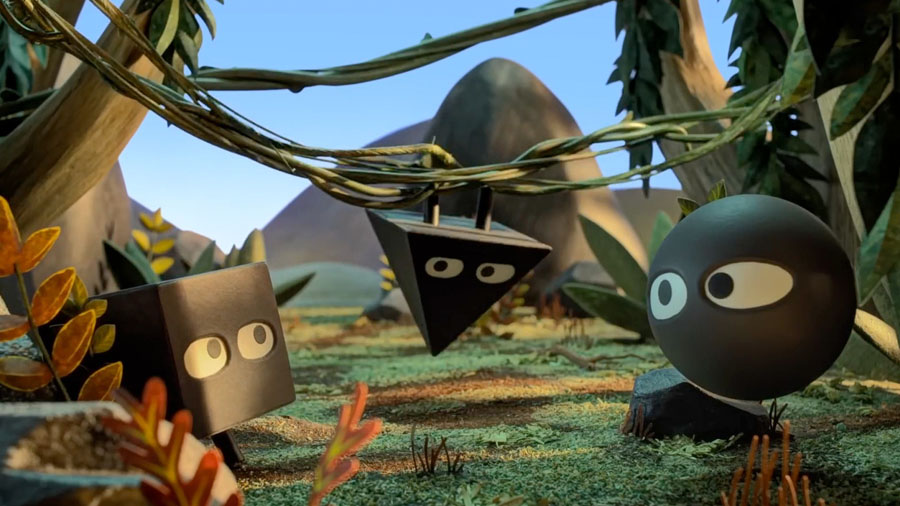
Mac Barnett and Jon Klassen are the creators and EPs of Emmy-winning and Annie-nominated stop-motion series Shape Island (based on their books). Season 2 of the family comedy premieres this Friday Aug. 29 on AppleTV+. (This Animation Scoop Q&A was edited for length and clarity.)
Jackson Murphy: Mac, Season One was a huge success. How has the reaction been over the last couple years and the prep going into season two?
Mac Barnett: It’s been great to see. Jon and I are proud of these books we made and I think part of the trick and what you hope to do when making television is that you wanna retain the soul of the piece, but also adapt it to this new form. Tell more stories. We’re so proud of this show. I think we’ve created a show that has what we love about our books. Honestly, this is our first show, so I don’t know if everybody says this to you, Jackson, but we like season two even better than season one. I think that the writers and the team just really started feeling like they knew these characters and just settling into this world.

Jon Klassen: They knew it in season one, too, just to be clear. They didn’t start to know in season two. Season One’s a good season.
MB: It’s a great season. You know, probably everybody says this to you, Jackson, but season one and season two are exactly of the same quality — and you should watch all of them equally and a lot.

JM: That’s right. They both give you what you want out of a show about a circle, square and a triangle. They give you that impact. They [really] do. Jon, this animation community loves and admires stop-motion animation. What have you seen over the last two and a half / three years from the animation community with the respect towards the work that you’re putting into this?
JK: I think they love the show. I think that’s actually been the most rewarding part of it. It’s hard to know how the intended audience is getting it because they’re in their houses watching it on television. But we do spend time with animation folks here in town and elsewhere, and those guys love it on a whole different level. They can understand technically what went into it and they can understand the craft of the team that we had and how lucky we were to have it. When we started we thought, “Oh, we’re gonna do these guys a favor. They only have to animate and build a triangle, a square and a circle.” And it turns out that’s extremely hard to pull off. You need to be very, very good to make it as good as this is. And they were.
MB: It turns out, first of all, that triangles, circles and squares are only two dimensions. We immediately gave them a problem, which they solved beautifully, but there was stuff like, no, but we keep hearing about this.

JK: I heard about it from another animator who didn’t work on this show. He wanted to know how they solved this, and it was a problem. Triangle in particular, as soon as he leans over even a little bit, his front hits the ground. I think they called it bulldozing or something. So we had to fix that. And they did fix it. And in the performance you can see them adjusting for it. But it’s stuff like that where animators can see what’s being solved in this elegant way where you wouldn’t notice it as you’re just watching it as a person who doesn’t animate. But we’ve heard really great things from everyone. Even with the writing too, we got great responses from writers of children’s things, being like, “This is something different.” And we were so proud of that because we thought so too.
MB: Jon, you worked in stop-motion before books, too. It should be said. You’ve got some deep roots in this community.
JK: I worked on “Coralline”. We kind of knew that these guys were gonna work or we hoped that they would work in stop-motion. We kind of conceived of them as little stop-motion guys and this kind of scale. Bou don’t know what you don’t know, right? I am a designer for animation, but I don’t animate myself. And so you think you’re doing them some favors or you think you’ve got some ideas of how this would go, but you’re relying so heavily on the team on the ground, and we were, and it worked out great.

JM: So what did you want to do then, Mac, for season two — as far as pushing the look, pushing the magic, and pushing the curiosity of animators and other people going, “Wow. How did they pull that off?”
MB: This is gonna be the opposite answer to your question, Jackson, but I think one of the episodes I’m most excited about that we just were laughing so hard is one where Triangle bets Circle that he can stay still for 11 minutes and he stays perfectly still for the entire episode. And we were just like, “This is the funniest stop motion joke.” (laughs) It ends up getting pretty wild. He sort of transcends space and time because he gets so bored standing.
JK: He’s never held still for that long.

MB: We have another episode where the characters aren’t really getting up to much. And our narrator, who is voiced by Yvette, Nicole Brown, just gets frustrated and tries to find a new story by just following the life of a bug. It’s such a gorgeous episode. But also just as a challenge for that team, both to change the scale at which we’re working, but also to immediately make us fall in love with a new character that nobody has seen before, but is gonna hold us emotionally for this episode. It’s such a credit to the animators, to the puppet makers over there. You come up with something that cracks you up on paper, but then this team has to make it real, and they just wowed us every time.
JM: These characters are very curious, and they’re very curious with their eyes. Jon, what are the challenges with pulling that off?
JK: I think it gives you a lot. We design them very deliberately to not have any range of movement in their bodies themselves. Most of what you’re getting emotionally out of the characters is through the eyes. Their mouths aren’t very expressive either. The mouths are very small and they move, hopefully, to give us a signal that they’re talking, but we can’t rely on them for expression. They’re too small and so everything is coming through the eyes. And again, you’re relying on your animators a lot, but we did try to limit their range so that their expressions were very clear from one to the other. And because their bodies are dark against whatever background is going on, you really get this great emotional series of symbols — and they’re often different from one to the other. A certain circumstance will give three different reactions from three different characters. And so the clearer that is, the more engaging and interesting, hopefully, the episode becomes because you’ve got these very different characters reacting to the same thing that’s happened. What we’ve found, even with books, but certainly with animation, is that kids’ window in is through the eyes. They’re looking to how to feel.
MB: Somebody says something or something happens and then we check in with each of our three characters to see how they’re feeling. And often it’s three different feelings.And if you’re clear about it, then you get that sophistication, you get that nuance, you say, “Look, this is gonna hit these three different personalities in three different ways.” And now you’re starting to talk about, “What is a community? What is a society?” A trio is the smallest unit that you can get that sophistication and show there are three different ways of looking at the world.

JM: There are so many iconic animated trios: Mickey, Donald and Goofy, Alvin, Simon and Theodore, SpongeBob, Patrick and Squidward. With Circle, Square and Triangle, it’s about their emotions. So a lot clearly goes into making sure those emotions are valid and truthful and honest and prominent over these episodes. You mentioned Yvette Nicole Brown. She’s done so much voice work over the years, and she’s so enthusiastic as your narrator.
JK: Her performance sounds like her having a good time. But when we’re working with her, she’s a laser-focused shark on the best take. The performance itself is always so sweet and genuine and I think that it is, but when we were working with her and doing takes and things, it was always… she’s so in control too. She’s such a professional about it, but also just loving. I think she really likes the show, which helped a lot. Wwe got a lot of confidence out of that because she is such a seasoned professional, and she genuinely made us feel like she liked the material — and that was such a boost for us. It just helped us write honestly, ’cause we could picture her saying that stuff and we would write it for her. And we tried to give her stuff that she would enjoy doing after a while and listening to what it is she liked to say… You can begin to adjust and react. I think that’s one of the reasons the second season was so much fun. We kind of had our tools with all the actors, but Yvette included.
MB: When we first sent her the scripts, she said that she had always wanted to play a narrator. Our narrator is a character. And she did deepen that.