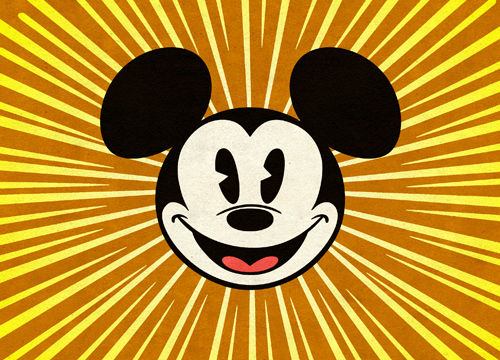
Mickey Mouse is an cartoon character co-created in 1928 by Walt Disney and Ub Iwerks.









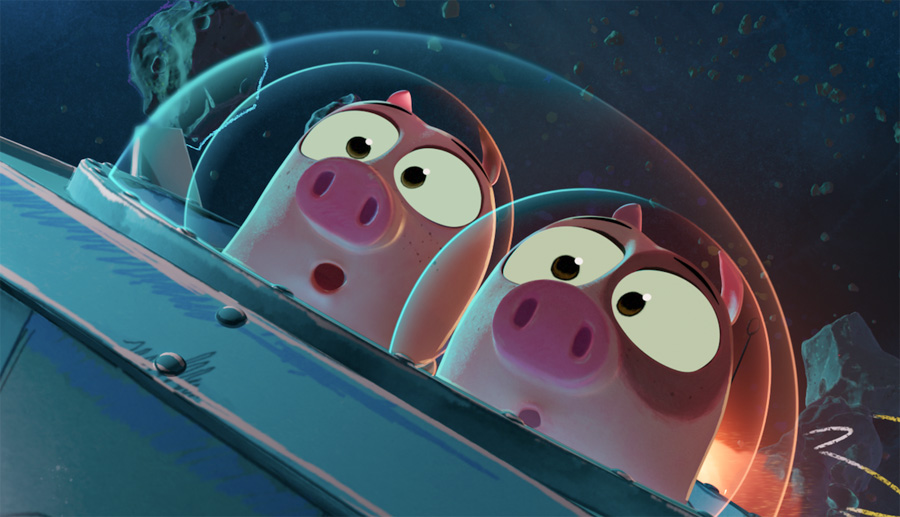
One of the 15 finalists for the upcoming Best Animated Short Film Oscar is Cardboard, from director J.P. Vine and Locksmith Animation, the studio behind features Ron’s Gone Wrong and That Christmas. A pig father and his children move to a new residence and discover the incredible power of imagination and a true sense of positivity and hope. (This Animation Scoop Interview with Vine was conducted as an Email Q&A and was edited for length and clarity.)
Jackson Murphy: Why do you think kids love playing with cardboard boxes?
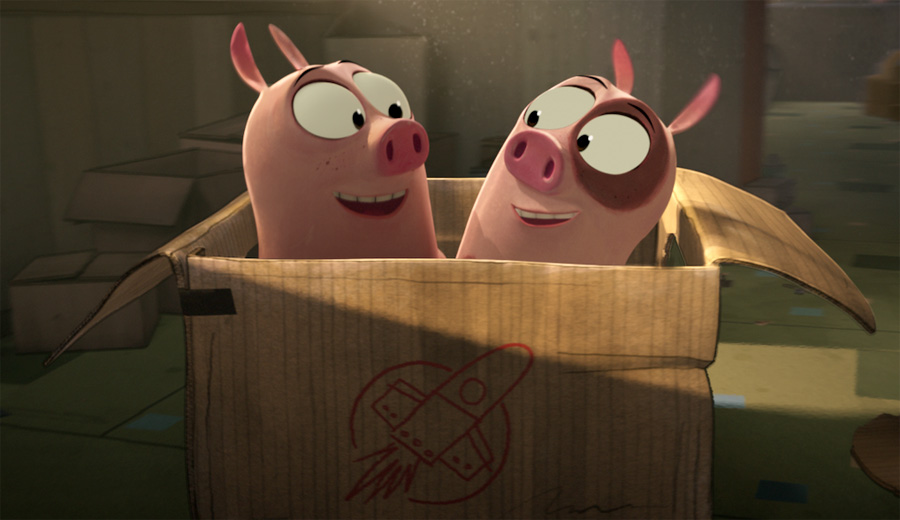
J.P. Vine: The best thing about kids is that they are natural storytellers and play-actors. They don’t have the self-censorship adults have, and can see anything as a blank canvas to become part of a story. So a box becomes anything that fits their story, something to jump inside, build on, draw on, and take on a whole new identity. A spaceship, a fort, a racing car. Anything is possible!
JM: How does the power of imagination inspire you throughout your life?
JPV: Coming from theatre design, I always loved how good theatre would involve the audience by trusting them to fill out the world on stage with their imagination. It got me thinking a lot about how powerful the audience’s imagination is, and how to lean into that. I found animation allowed me to get into that sense of world building even more, and it has never failed to amaze me that we get to design worlds and basically be at play for a living. In this short, I’m also trying to say that we need our sense of imagination and wonder to get us out of our own limited view. We need imagination like we need oxygen. To see what’s possible.
JM: How did you want to present the theme of connection in your short?
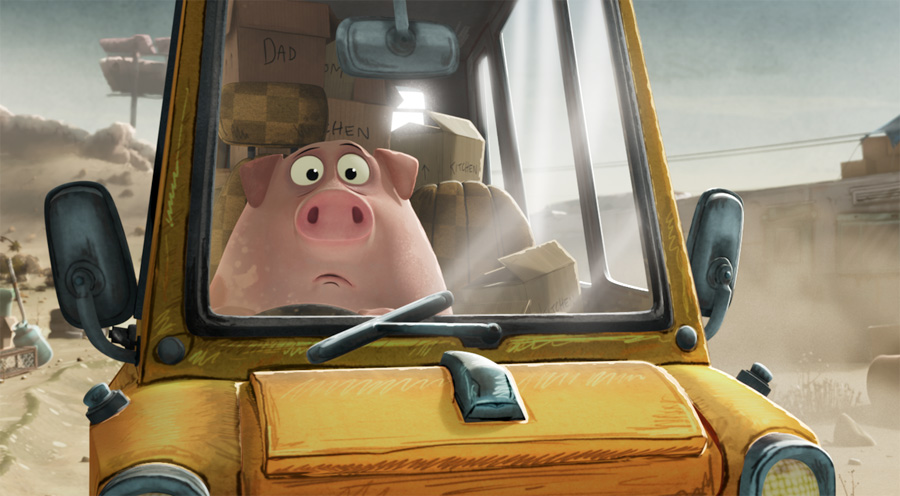
JPV: The short is about a family arriving at a very unpromising new home, and we see two very different reactions. A worried and troubled Dad, vs his two kids who see this place as a launchpad for something new. We intercut between those two ways of seeing, until a crisis hits Dad and he’s faced with a choice. Can he see the world the way his kids do? That’s where the moment of connection comes; the kids have led the way for him to see this change as a new adventure.
JM: How was the editing process of this film? You go back and forth between a few locations in very successful ways.
JPV: That concept of ‘two ways of seeing’ drove the entire edit as well as the design language of the short. I loved the idea of crosscutting between what the kids imagine, and Dad’s reality. By match cuts, sound cues, or composition, we could push constant, fun jumps from what’s going on in imagination to the consequences in reality. The energy of the cut was intended to match the piglet’s relentlessness. Conor Wilson, the editor, really set and protected that kinetic energy through the short.
JM: You’re an Annie nominee for “The Good Dinosaur”, and you co-directed “Ron’s Gone Wrong”. How did your work on those films prepare you for “Cardboard”?
JPV: “The Good Dinosaur” is probably the most ‘Ghibli’ like movie in Pixar’s canon. We really strove while boarding to let the movie breathe: expansive, non-verbal storytelling. It was a delight to work on, even though we were under some real production pressure. The scene I was co-nominated for was a quiet and soulful scene, the kind I love to board. Scenes that prompt the audience to lean in. I wanted “Cardboard” to have a balance in tempo: between the comedic intercutting energy of the kids, and the quiet, heartfelt moments with Dad. “Ron’s Gone Wrong” was an epic learning curve for me as a first time co-director; it was the first time I had made CG past the story phase. I had to get up to speed with editorial, working with actors, and a huge animation crew. We got a result I’m still proud of, a sincere and funny movie. Distilling the process down to a short film for “Cardboard” felt like a walk in the park!
JM: How does “Cardboard” represent what Locksmith Animation stands for in 2025/2026?
JPV: When we made “Ron’s Gone Wrong”, Locksmith was a startup with a vision for big-picture family storytelling. With the success of “That Christmas” hopefully audiences are now connecting the name Locksmith with beautifully crafted, ambitious films. While the studio is preparing two huge new features, we used any spare time to make “Cardboard”. It’s a chance for the studio to explore a new visual look with that same story-driven feel. It was important for the studio to foster an internal short, elevating crew into senior roles, building more creative energy inside the studio, and showcasing more range to the outside world.
JM: What would an Oscar nomination for “Cardboard” mean to you?
JPV: It’s one of those childhood dreams, isn’t it? Going to the Oscars with a personal short story, made with a crew who gave so much energy and love to it, would be incredible.