Mickey Mouse is an cartoon character co-created in 1928 by Walt Disney and Ub Iwerks.











Join me and series director Sam Dransfield for a “Dinogalactic” conversation about the new animated family program Tim Rex in Space. It premieres next Monday Aug. 4 on Nickelodeon. (This Animation Scoop Q&A was edited for length and clarity.)
Jackson Murphy: What excites you about this combination of Dinos and outer space? It seems like it’s just meant to be.
Sam Dransfield: I mean, the question sort of answers itself, doesn’t it, Jackson? It’s dinosaurs and space. Was there ever a better combination? If there is one, I’ve not encountered it. It just does everything you want it to do. It’s certainly two of my greatest loves in life, dinosaurs and space, finally brought together. Why did it take us so long? (laughs)
JM: It reminds me of going to a lot of mini golf courses when I was a kid.
JM: And there would be Dinos with putters and the space theme — glow in the dark. So it’s perfect. And of course, we just had another “Jurassic” movie open, “Jurassic World: Rebirth”. So why do you think kids and families love T-Rexes?
SD: Just thinking back to my own dinosaur obsessed childhood… dinosaurs are just sort of endlessly fascinating, endlessly interesting. There are so many facts to learn about dinosaurs. I’ve got a few young nephews at the moment and those guys are just full of dinosaur facts to the absolute brim. It seems to be a topic that grabs kids’ imagination and refuses to let go, because I’m not a kid anymore and I’m still obsessed with dinosaurs.
JM: We’re all kids at heart who love these dinosaurs. And we have this loving family, Tim and his family. Tell me about creating the personalities of the family and how we see that over the episodes this season.
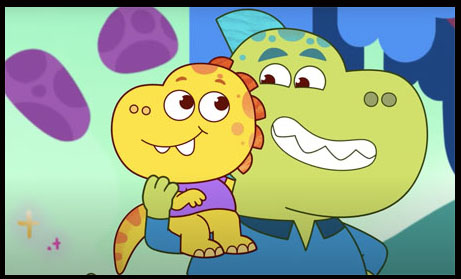
SD: All of our episodes start with character, and that applies to the series as a whole as well. So despite the fact that we quite early on hit this vein of dinosaurs in space, just as important as that was coming up with a character for Tim and making sure that he feels well-rounded and believable and lovable and real and recognizable. And I really hope that we’ve managed to create a character that audiences can connect with and that kids can see themselves in, despite the fact he’s a yellow dinosaur that talks and lives in space. I really hope that kids can watch the show and see some of themselves reflected back at them — not just in Tim, but in the whole family as well. So that also applies to anyone else that might be watching the show, be that parents or other relatives or siblings. There a piece of the puzzle for everyone.
JM: And what I noticed from the first episode that I got to see, which is three stories in 22 minutes, is how much of a warm environment you create. How important was that for you?
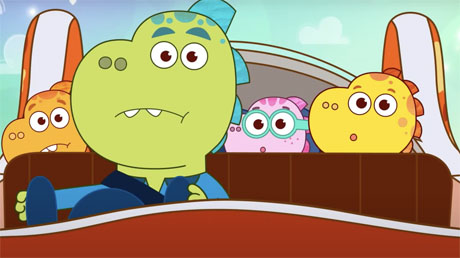
SD: Super, super important and I’m so glad that you brought that up. One of the early challenges on the show was that space intrinsically is actually quite a hostile, cold place. Space, by definition, is the absence of anything. So how did we warm that up? What we did was try to present a version of space that was warm. We don’t have a big black, endless void. We have a colorful night sky full of nebulas and stars, and it’s almost like someone’s taken a watercolor brush to it. We really tried to make sure that we did have a lot of heart and life and all that good stuff in every part of the show. And not just in design, in every single part. So we made sure that stories we engage with are full of heart and built in that kind of honest, earnest way.
JM: And I have to imagine that because you set the show in space and you create this environment that the possibilities for storylines are endless. How do you think about all of that and go through what’s gonna work — and the power of imagination with these stories?
SD: Space is quite literally infinite, by current understanding, so we kind of have two approaches to generating themes and topics and ideas on the show. One is: half of the show is very out there. It is quite literally out of this world. Tim lives on an asteroid field in space. But he also deals with normal everyday kid stuff. He has arguments with his little sister. He babysits a parrot one day and it flies away and he has to get it back. He has to go to the shops. He has to do this and that. So despite the setting being as outlandish as it is, it’s all coated in this kind of very recognizable, relatable thing for viewers. So just making sure that that relatable part of the show is there at all times.
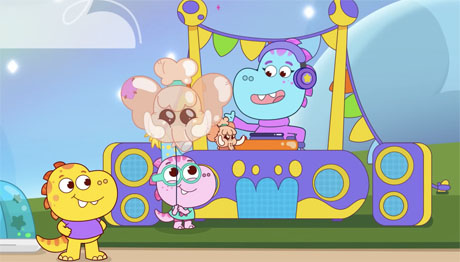
JM: When it comes to the visual inspirations, do you look at planetariums? Do you look at books? What were your guides for the visuals of this?
SD: You know what, Jackson, we look at all of it. We look at all of it. So space and dinosaurs, there’s so much material out there on both of those things. One thing that really excited me about the idea early on, and one of my big passions in life, is sci-fi and space. And so we try to get a lot of that kind of sci-fi flavoring, that sort of retro futurism where everything feels kind of different and special. But again, making sure that it was all recognizable and relatable. So, a great example that I like to use is early on we made the grass in this world pink, and the sky was orange and trees were blue because we thought, “We’re in space. We can do whatever we like.” But we adjusted away from that and decided that we actually wanted more of a kind of recognizable, terrestrial feel to the world. So now grass is green, and the sky is quite often blue because we wanted to have those inspirations that I was talking about, those kinds of sci-fi fun, juicy stuff — and then make sure that it was still recognizable and understandable to this audience. Early in the development process, we were just pulling from things that really excited us as kids. So lots of your classic kids books and classic children’s illustrators to get that kind of… what I like to call that tangibility, where every frame of the show you wanna take a closer look and really just reach out and touch it, and you want to take part in that world.
JM: And as I mentioned, it’s three stories in 22 minutes. Do you ever feel limited because of the time constraints of that, or do you feel like seven minutes is good… you can flush everything out in that amount of time?
SD: I think it’s one of those artistic constraints that kind of prompts creativity. I’m sure that the team would do a lovely job if we had 25 minutes for every episode, but by making it seven minutes per story, you’ve got to be efficient with your storytelling and you’ve got to be clean. And I think that forces a way of working that has worked out really well for the show. So we do have to be strict with ourselves and make sure, “Hey, is this story beat needed or can this go in favor of something more important?” Andy Potter, our incredible head writer, and the writing team have really distilled that down to a formula and got it to a fine art.
JM: Nice. One of the themes of one of the episodes I watched is about listening to what others have to say, and Tim really learns that through experience. How do you apply that to working on a show like this?
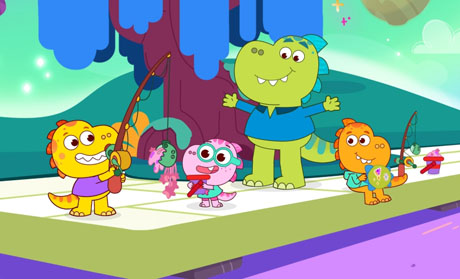
SD: One thing I really tried to instill on this production was that it really does take a village and… it’s a collaborative environment that I try to encourage. I like to point out that good ideas can be found everywhere. I like a little bit of interdepartmental crossover. So just because you work in the character design team doesn’t mean you can’t come and sit in on a storyboard meeting because you are gonna learn things that are gonna inform your character design and vice versa. I really like to give everybody a voice and make everybody feel like they can speak up, because that’s how you find the best ideas. It really does take a village, or an asteroid field.
JM: (laughs) That’s important. That’s great that you do that. And what would your dream spaceship vehicle look like?
SD: This is an easy one. Tim has a rocket powered scooter that he flies on in almost every episode, and the designers did such a lovely job in making that look so cool. And it’s got all the bits and pieces that I mentioned. It’s got that retro sci-fi feel, but it also looks very real and it runs on this incredible pink space fuel called Astro Dust. So my dream space vehicle would be Tim’s astro dust powered scooter.
JM: Boo-yah! That sounds like fun for sure. And Sam, what would you say has been the most “Dinogalactic” part of this whole experience of making “Tim Rex in Space”?
SD: The easy answer is that the team that we’ve built on this show, every single part of the team, is just firing on all cylinders and doing such amazing work… that I think the most “Dinogalactic” part has been working with our incredible teams, be that design, sound, visuals, animation. Every single person on the team… we’re all on the same page and everyone’s firing on all cylinders. So for me, it’s been the team.