Mickey Mouse is an cartoon character co-created in 1928 by Walt Disney and Ub Iwerks.










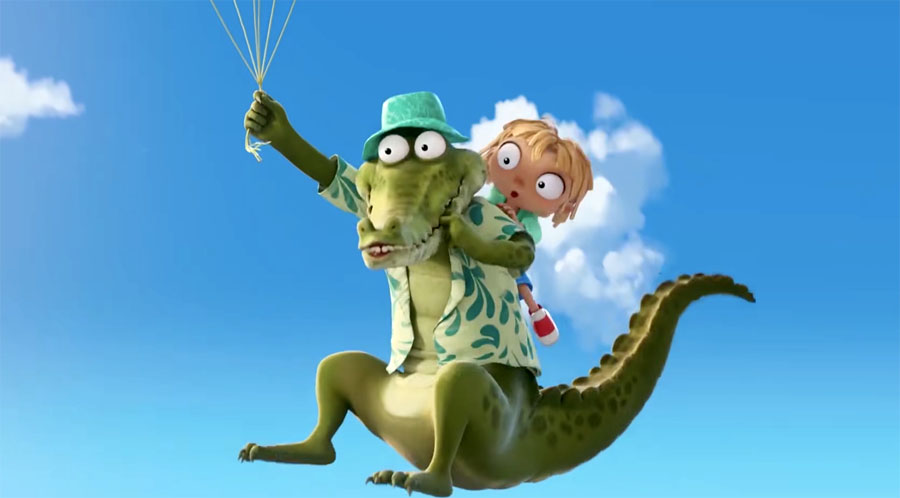
Aton Soumache is the producer of new family animated series Mr. Crocodile, premiering Monday Feb. 23 at 10:30am. Soumache is also proud to have produced director Sylvain Chomet’s Annie Awards nominated feature A Magnificent Life (in theaters Mar. 27) as well as modern animated classics The Little Prince and Little Nicholas: Happy As Can Be. (This Animation Scoop Q&A was edited for length and clarity.)
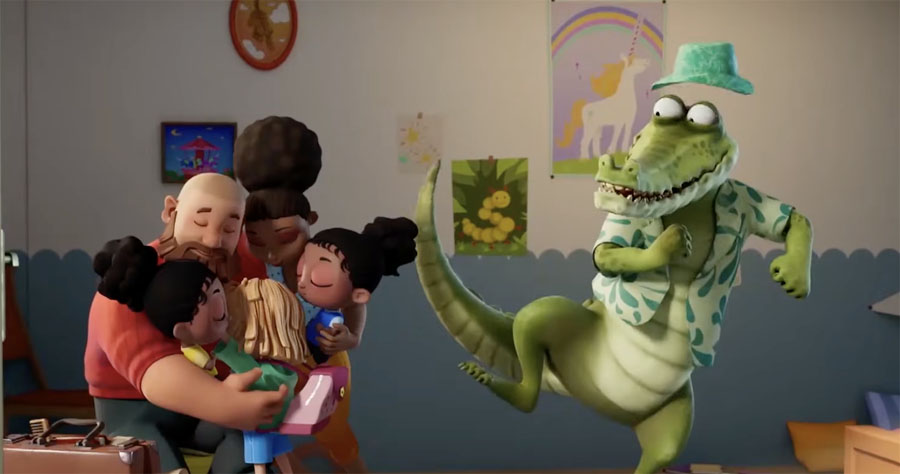
Jackson Murphy: This series is based on the work of artist Joann Sfar. It’s about a large talking crocodile and this young girl Daisy and their dynamic, their relationship. What interested you in being a part of this series and having it come alive?
Aton Soumache: Joann Sfar is one of the most famous comic book creators in Europe. Twice bestseller in New York with a lot of comic books. He created 300 books, He has adult and kid books. We have a company together called Magical Society, which is producing the show. And when we saw this little Mr. Crocodile with Daisy in a little book, because it came from a little comic book, an incredible small book, it was really amazing. It was such an intimate relationship in 30 page books, very soft, with a little crocodile. And Joann said, “I would love to see this in animation.” I said. “Yes, maybe we can do something, but we have to do the same adaptation of “Shrek”, meaning you cannot keep this 2D, arthouse type design. We need to put it in CGI to go tell the story to a lot of kids. And we started to make [animation] tests and very quickly we understood that we had a very unique relationship and a wonderful TV show to do for kids.
JM: Yes. I love the dynamic of the two of them and I love that Mr. Crocodile, in the episodes I screened, learns so much [including] about the characteristics of a good birthday party. And the viewers / kids are learning right along with him. Was that a goal to have that be a core of the show?
AS: Yeah, definitely. I mean, of course we want to entertain the kids, but we also try to make things that are smart and help kids to learn things. You’re so influential [for] young kids. It’s very important to show the value that you have beyond your show. And I felt that even if it was very funny, very cute we also want to help kids who are growing up and be ready to understand this crazy world in which we are here and get them the good value to understand what you are allowed to do, what you are not allowed to do, what is having your instinct, what is understanding the other and socialize yourself in the world. So a lot of very simple but very powerful meaning behind our show. And I was very happy to do it through this reverse relationship where [the] crocodile tried to learn how to be a normal human in a life in the world.
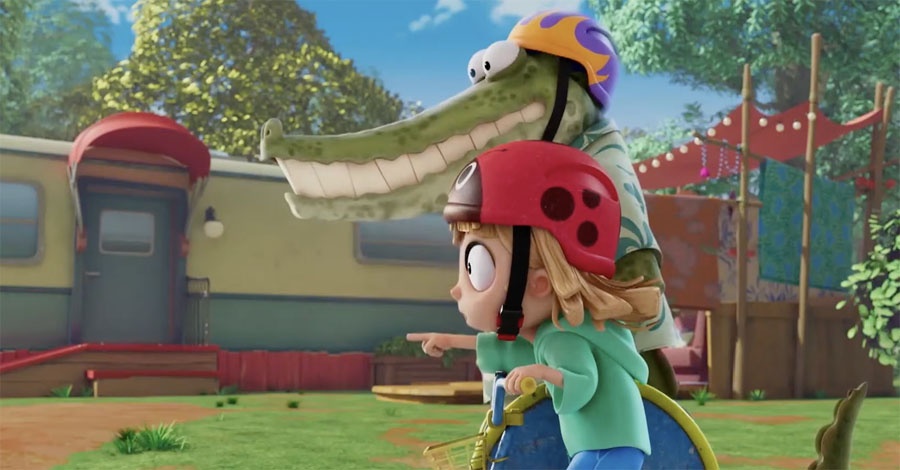
JM: The mobile home community setting is an opportunity as well for kids to learn so much about interacting with other people, meeting other people, humans and animals. All the creatures and the friends in nature that Mr. Crocodile has as well. Tell me about creating that setting and the dynamic.
AS: It was very important for us to craft something out of the box. Not always the same thing with the houses. Something in the nature that you can mix different [things]. So this mobile… this little caravan / this little house that we created in the middle of the nature where you can have on one hand the classical town and the other hand nature and all those characters being here in this. It’s a little playground that we created that was quite important for us in terms of design. We wanted to have a playground where everything can happen.
JM: A lot does happen. And you create this atmosphere that is also bouncy and bubbly. The humor, it’s a distinct style of humor that I don’t know if we always see on American animated television. It’s cool. It’s bubblier and I like it because it’s very positive.
AS: Exactly. It’s interesting what you’re saying because we wanted to make this bridge between something very sophisticated, created by a very intellectual writer that does something very, very soft, very shiny and positive — but on a very small scale, very intimate. And we wanted to make it for everybody. So having Nickelodeon on board and all the U.S. talent that we had on board and EP with us, they all fell in love with the book. But they said, “Let’s try to make this broad,,, as big as possible, that talks to everybody.” So exactly what you said. We have the best of the U.S. talent and feeling about making a great, funny, energetic show with this very sophisticated talent, and this DNA that was keeping in. So it’s quite a unique show. It looks like something that you’ve seen, but it’s when you get in and you go deeper in it, you understand it’s at a very unique taste.
JM: Adapting from these books and making 11-minute episodes — Were there challenges with that, with expanding out the story?
AS: Yeah, it was challenging. We wanted [Sfar] to feel comfortable. So we took time to find the best way. You know, as Hitchcock said, “The best way to do adaptation is not to respect the book, but to keep the DNA.” So it was this balance. We had to find a way because it’s a different medium. The main thing was to adapt his style from 2D to 3D. The spirit in it has a childhood soul. He loved what we wrote. “It’s smart, not stupid. I understand. I trust you. Make it happen.” And the great thing is that Nickelodeon didn’t take a show to take a show. They really felt that there was something unique in those books, in the story, in the style, because it’s quite a funny style. And even this crazy idea of a relationship with a girl and a crocodile. They love this. Today I think you see so much stuff that… it’s very important to have something out of the box that you bring to the market, to everybody, by trying to have original values. Yeah. Absolutely.
JM: You also produced “The Little Prince”, which was my favorite animated film that year. The depth in that script and the voice cast… the look of it glowing. Love that film.
AS: Thank you. It was one of the big challenges of my life. I mean, I thought I could retire after this movie. It was so much energy that I put in this movie. “The Little Prince” is one of my most favorite books. How do we have to build a relationship with others and keeping the childhood soul? And even if you look at [“A Magnificent Life”] it’s: Never forget that you were a kid.
JM: Quite an achievement. And speaking of the importance of childhood and that joy, my other favorite animated film of the particular year this movie was released, you also produced… so charming and moving: “Little Nicholas: Happy As Can Be”. Delightful.
AS: This was to talk about creation. What is it to create something based on your childhood? It was very original. The same theme that I love: understanding who we are and how we can keep in that crazy world a shy soul. I think if we do this more, the world will have more wisdom and be more safe.
JM: You have been a part of many fantastic animation projects. What has producing animation meant to you throughout your life and career? How has animation been a touchstone for you?
AS: Talking to you, it’s a touchstone. Animation is a universal language and the fact that you can see my movie… I’m a little French guy living in Paris who wanted to make crazy stuff. I wanted to make a thing that can talk to the world, and animation is the best entertainment thing to produce and content to do because it has no borders. It’s a universal language. You can go over the world. It’ll be taken as it is with universal message. Living from Paris and being able to have those shows traveling the world, being able to have you talking about those shows, seeing the shows, this is my main motivation. The pleasure to produce an animated show or movie is a collective work. We all work together. All these people are talented and they need to be there to make the animation happen. It’s a very long journey. It’s a marathon — but a wonderful journey.