Mickey Mouse is an cartoon character co-created in 1928 by Walt Disney and Ub Iwerks.











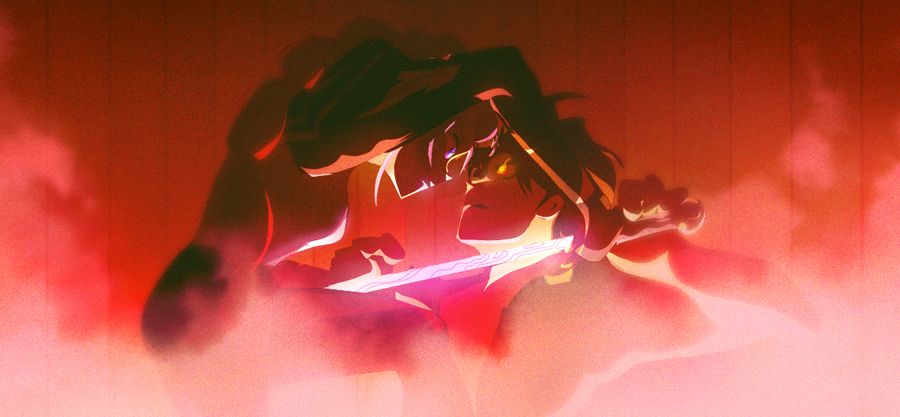
It’s not surprising that the bathhouse battle is the third most popular scene from KPop Demon Hunters: the Netflix phenom and Best Animated Feature frontrunner from Sony Pictures Animation/Imageworks. It’s colorful, funny, chaotic, and action-packed.
HUNTR/X follows the Saja Boys into the public bathhouse, where they’re ambushed by water demons. The frantic fight contains weapons and slippery floors, and it becomes the pivotal moment when Rumi’s (Arden Cho) half-demon identity gets exposed to Jinu (Ahn Hyo-seop) when markings can be seen through a tear in her dress. This leads to an emotional connection and sets up her ultimate self-acceptance and the group’s final victory.
The importance of the location meant that it was one of the first set designs, with director Maggie Kang conveying the ’80s look of Korean bathhouses that she remembered from her time living in Seoul. “We were very conscious of wanting to showcase something from that era with those retro colors of green [for the tiling] and orange [for the wood paneling] in the hallway and then the most intense orange ending in this super hot moment in the sauna,” explained production designer Helen Chen. “It’s a very cohesive color statement for the storytelling.”
The space was designed to be like a sandbox that could be moved around depending on the action that needed to showcased. “The set is actually incredible, but you don’t see it all because it’s so steamy,” she continued. “The hallway was a couple of pieces that were assembled, and the ceilings have very specific tiles in the saunas. We wanted to make it as authentic as possible, so there’s even little plastic stools. Even the modeling and animation team would collaborate on faucet shapes because so many of them were Korean.”
The bathhouse was also one of the first set pieces where the animation team tested wide angle lenses as part of their anime-inspired aesthetic for the CG “It was really important that these things be really glamorous, and that meant soft lighting and big blur, and we couldn’t flatten things out and go so graphic,” said Josh Beveridge, head of character animation for Imageworks. “I wanted the clarity and timing and shape language of this graphic world.
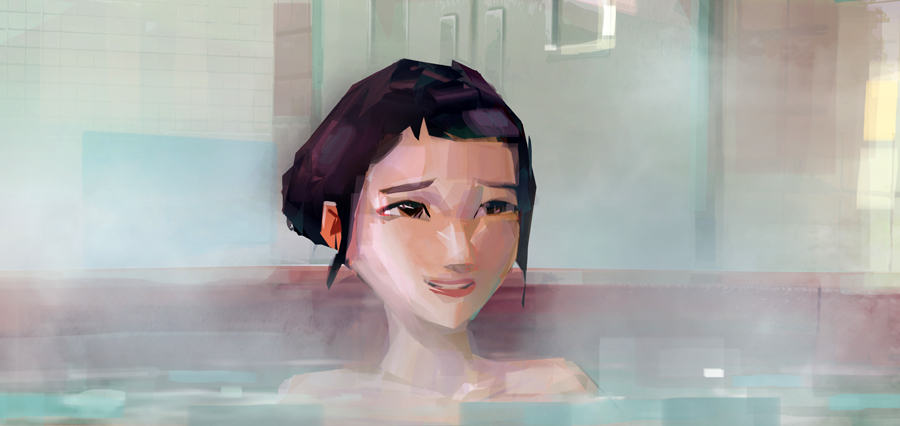
“And because anime is 2D,” he continued, “you need to figure out how to play with that shape language. When I came on in the beginning, one of the things we talked about is how do we translate a 2D style in a 3D context and not shy away from that challenge. Some of the first animation tests we did in the VizDev department was: How do we go from a normal model into this Chibi style [extreme deformation] that’s very endemic to anime? It had to be sculptural and they never wanted brushstrokes. We would reference vinyl toys and solve it and it had to work under glamour lighting.”
Thus, if the Chibi look got too flat, it would separate it from the rest of the environment and ruin the effect “We would change the shape and size of the bathhouse, depending on the actions,” Beveridge added. “Because one of the other things you see in anime is imperfect perspectives, like really forced perspective beyond what is literal. It’s a warped D perspective and we would do that in the camera lens. That would change the performance and the shape of the characters and the room with the camera. So it would feel like they’re deliberately not in sync with each other. The characters are in their own zone of space when they’re in superhero mode. So it’s altering the reality.”
And they reserved the most extreme distortion for both action and comedy in the bathhouse. This included objects on faces, such as corn eyes. “Getting Chibi to work in 3D was hard,” Beveridge admitted. “We went through this whole journey where we went too far and it took you out.There’s no such thing as a three-dimensional sculptural solve for this, and we needed to swap in stunt pieces when we went super chibi. We built this whole network of masks and think like Mr. Potato Head.”
The other important element was the fight choreography in the bathhouse, which served as the basis for the Chibi-style animation. The K-Tigers stunt and choreography team were hired to create “K-action” scenes, which combined Taekwondo-based kicks with swords and spears.”We hired the K-Tigers and they sent us lots of reference and we would watch all these clips and thought of them as LEGO pieces we might use in one place or another before we learned how heightened and how far we wanted to go,” Beveridge said.
“We would also see these little glimpses of movements they do in their setup and preparing before they record their [fight choreography], and that was a one of the biggest epiphanies,” he added. “We were trying to figure out the girls’ personalities early on and how to define them. We realized they should already be fight experts and not learning their craft. And the K-Tigers would do these little hops and shoulder shimmies and push ups, and when Maggie saw that, she wanted to see cheekiness in the fights. It’s not about how cool the punches are. That’s secondary to seeing the personality and how they’re doing it to [have fun].”