Mickey Mouse is an cartoon character co-created in 1928 by Walt Disney and Ub Iwerks.













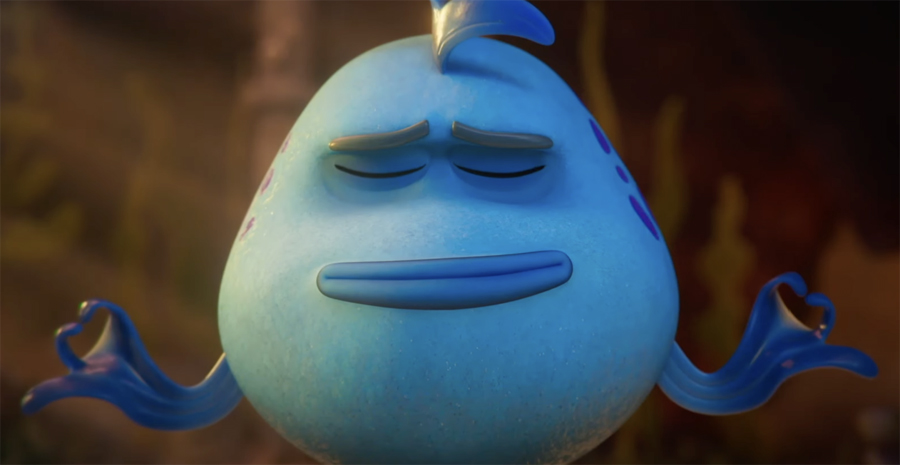
The Pout-Pout Fish, adapted from Deborah Diesen’s popular book series, is a new animated feature in theaters nationwide on March 20th. Mr. Fish (voiced by Nick Offerman) joins seadragon Pip (Nina Oyama) on a quest to have their wishes granted — for safe and habitable homes in their undersea community. On this fun and sometimes dangerous journey, they, along with a cuttlefish named Benji (Remy Hii), will learn important, life-changing lessons. (This Animation Scoop Q&A with director Ricard Cussó and writer Elise Allen was edited for length and clarity.)
Jackson Murphy: Ricard, Congratulations on “The Pout-Pout Fish”. I also have to congratulate you on “A Sloth Story”. I spoke with [co-director] Tania Vincent about a year ago for that. And you really love these adventurous animated features with great central animal characters.
Ricard Cussó: What can I say. That’s kinda bread and butter now. “A Sloth Story” was such a beautiful film, and now “The Pout-Pout Fish”. I’m just excited and honored of being asked to direct these films and being able to tell these stories for the world.
JM: They are terrific stories. Great for all ages. Elise, how did you first come across the book? Was it the first book? Did you know about the series heading into writing this “Pout-Pout Fish” film?
Elise Allen: I had heard about the book because it’s a very popular book. Deborah Diesen’s book is a New York Times bestseller. All the parents I know of small kids are obsessed with it. So it is very much out there in the zeitgeist. But I hadn’t personally read it or had much contact with it one-on-one until Like a Photon [Creative] reached out to me and said that they were partnering with MIMO [Studios] and they were really excited about this project. This was in fact the first book property that MIMO ever optioned. And then they wanted me to look at it with an eye to, “What would I do to expand it to a feature?” So I read the book, and the book is as fantastic as everybody says. It is a small scale story. So what got me very excited was: How do I take this core character and expand the world and expand his adventure so that it makes sense to be a feature film?
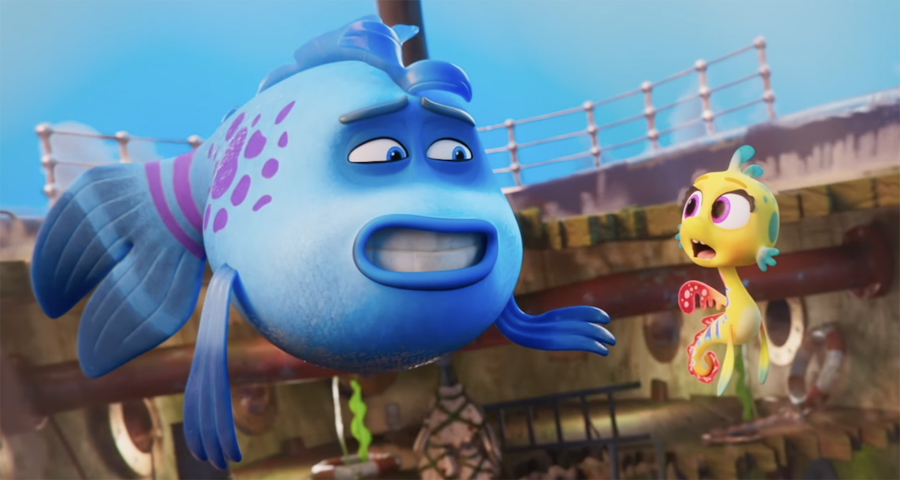
JM: Yes, there are a lot of characters. There are a lot of surprises, and I think families are gonna enjoy following along these adventures, kind of parallel levels to it. Ricard, it’s about finding a new home, protecting your home, protecting your community. And you showcase this undersea community, which is gorgeous and lively. What were your goals with presenting that visually?
RC: Wow. Great question. I think that it definitely was a challenge to do an underwater movie. One of the worst things in animation, unfortunately for us, smaller studio from Australia, is that it doesn’t matter who you are, you always get pit against DreamWorks and Pixar. The audience doesn’t care about the budgets or doesn’t care how the film got made. So it was a challenge… “How do we portray this underwater film that can stand up against these films?” And we were not aiming to fight the big guys, but we want to do something that we’re really proud of and something that families of all ages would love watching. One of the big challenges underwater is: You expect everything to be blue and to be gloomy. You can’t really see far in the distances. How do we make this world alive and different and unique? So really, from the get go, we set out… “Okay, let’s make each environment unique.” So every time that they go from A to B to C, it just feels different. To go from the incredible little metropolis we did where Mr. Fish lives, and then we’ve got Dolphin Cove, which is this over exciting pink extravaganza where the pink dolphins live. We have this incredible dark location where Mr. Fish has to face his deepest secrets. So that was always part of the game. How do we keep the audience engaged because thestory is doing its beautiful thing. So how do we support that visually? Just keeping everyone on the toes… what they expect that they’ll see underwater and surprising them with all these different kind of locations and characters.
JM: The locations are fun. You do a great job with all of it. And Elise, Mr. Fish has a pout-pout face. He seems unhappy. He seems like he wants to be alone and wants to find peace. And yet the flashbacks that you show offer more layers to that. The flashbacks are some of my favorite scenes in the movie because they’re very well done in how you approach them.
EA: Mr. Fish was a really interesting nut to crack from the beginning. First of all, usually with a kids’ movie, often you’re coming in from a kid’s point of view, and we do have Pip, but our main protagonist is Mr. Fish, who’s an adult. So what is it that’s going to get people of all ages excited about this character? And he seems so surly and curmudgeonly. So to figure out what’s behind him? Where’s the humanity, the fish-anity inside him that really draws you to him? I had amazing co-writers, Elie El Choufany and Dominic Morris, and it was really important to us to make sure that Mr. Fish was three dimensional. And those flashbacks were a really great way to just show what happened to him. “What hit you emotionally to get you there?” And we were able to do it with what I felt was a really nice light touch where you’re experiencing it with him. We’re not hammering the message over the head, but you get that he came by his attitude, honestly. And so you feel for him and you care for him, and you really wanna see him go on this journey to break out of this self-imposed exile.
JM: Pip the seadragon is so energetic. Ricard, how was it playing with that contrast of personalities and allowing their relationship to really develop?
RC: I think that’s what makes the film. You wanna make the film interesting. You wanna be engaged with the story. Put two characters that are complete opposites. And it is really the odd couple of Mr. Fish wanting to be by himself. It’s intimacy, it’s all his own way. And then Pip put just goes out in the world and loves meeting people. And to her, she sees the good in everyone, right? Mr. Fish… it’s not that he sees the bad in everyone, but he’s always afraid of “What if things go wrong?” So going into this quest adventure, which already has its own kind action and drama and comedy, but then seeing it with them together, it’s great seeing them play off. Having Nick Offerman as Mr. Fish… you’ve got this very American incredible deep voice character and you pit him against Nina Oyama, who’s an amazing Australian comedian. Seeing that play out in the screen is awesome. So as a director it was so much fun.
JM: Nick is very talented, and his voice is so distinct. What surprised you, Ricard, about seeing him in the booth? Approaching this character and that deep voice he has [and] the range that he can give with that.
RC: The surprise was how much of a good human he is — how easy it was to work with him. How open he was to try things and… being in the booth and talking between ourselves and seeing where we can take things. To be honest, it felt like he was born to play this part. I remember when we were doing this first script reading with just the production crew. “Who are we gonna cast?” And I said, “Oh, Nick Offerman would be pretty cool.” It sounded like a dream. How would we ever get him? But Like a Photon managed to get him on board. He is what I pictured when I was thinking and I was reading the script and I was doing the first stages of storyboard. It was terrific, and it was such an honor to work with him.
JM: That’s awesome. And Elise, I think one of the important themes of “The Pout-Pout Fish” is caring for others. What does that theme mean to you? How important was it for that to be a core theme of this film?
EA: Incredibly important. What’s interesting and what was fun and what we tried to build is that you have these three main characters who ostensibly are looking for their home in a physical sense. You’ve got that central question of, “What would make someone risk everything for the place they call home?” But they find over the source of looking for their physical home that home is in connection with other humans, or in this case other fish. But it is in that person to person, that soul to soul, fin to fin connection. It’s so important for kids, for adults, for everybody right now. We can be so divided with our faces in the screens all the time — it’s so important to realize that making these connections with everybody around you… that’s how you’re gonna find home. That’s how you’re gonna come into your own. It’s building that sense of community. It means everything. And that’s what’s gonna change you from a pout-pout fish who’s by himself to this active member of the community and the world.
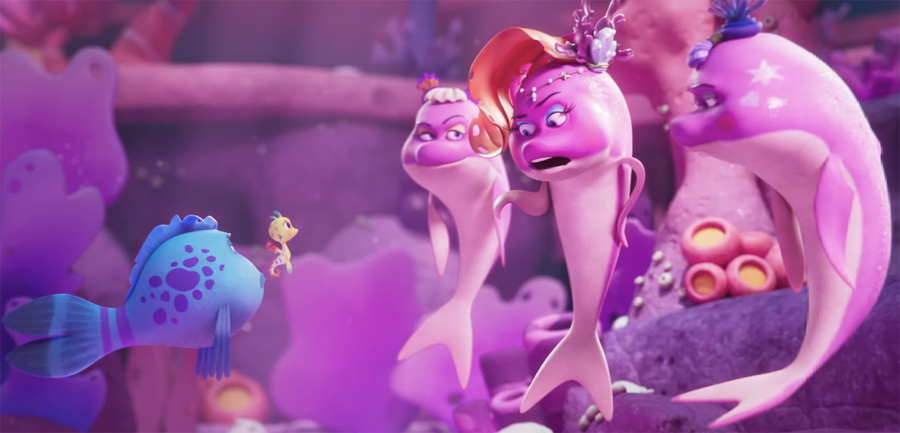
JM: That’s very good. And Elise, you made sure to include in this movie some key “Mean Girls” references. Are you a big fan of “Mean Girls”?
EA: Yes! A fan of the movie. Fan of the musical. Yes. They made Fin Happen and I was so happy.
JM: Through the books, through the stage musical, through now this movie, why do you feel that “The Pout-Pout Fish” is a great family experience for the here and now, for 2026 — and what [do] you hope kids will take away from this experience in the here and now?
RC: Well, to me this film was quite personal because during production my first daughter was born. Becoming a father kind of unlocks all these windows to look through that you just didn’t know existed. Going back to what you mentioned about the flashbacks, I think something at the core of the story that really stuck to me was the power that the opinion and the voice of your parents have over children. The reason why Mr. Fish is the way he is when we start the film is because his father told him the world is cruel and you’ll be better off if you stay shut off yourself. He really believed that as a kid and he grew up thinking that. And just realizing… kids look up to their parents and they want to be like you. And I think that this story kind of shows you that parents… we don’t always have it right. We make mistakes and we see things differently. And I think this movie shows you, and kids should take away that, your life is your life and you should be able to see things your own way. You’re not dictated by these confines. And you can extrapolate it… You don’t have to be told who you are or who you want to be. And you have your own will to see the world and see life as you see fit. Befriending and connecting and living life among other people, or fish by this matter, is what’s really gonna unlock life to its full potential. To me, that’s the key takeaway. The film offers that view, and I think it’s a beautiful message.
EA: You really, in the end, discover that it all has to come from you, in the best way. You get help from others but it’s all of you working together, not looking for an outside source. By coming together, finding community and digging into what makes you you, that’s how you make your dreams come true.