Mickey Mouse is an cartoon character co-created in 1928 by Walt Disney and Ub Iwerks.












Animation Scoop‘s coverage of the 2026 Oscars shortlisted animated short films continues with Autokar, from director Sylwia Szkiladz. Young Agata is on a bus, traveling from Poland to Belgium. On this memorable journey, she interacts with many fellow passengers, imagining them as animals. (This Interview with Szkiladz was conducted as an Email Q&A and was edited for length and clarity.)
Jackson Murphy: What do you love the most about your lead character, 8-year-old Agata?
Sylwia Szkiladz: Agata moves me with her love for the other passengers, her curiosity, and her way of looking at the world, always ready to listen and observe with great sensitivity. She gets through difficult moments thanks to a luminous imagination, capable of elevating what is emotionally challenging and revealing its beauty. Carried by the vibrant and authentic voice of Natalia Wolska, which makes her even more endearing, Agata reveals an inner strength that transforms her fragility into a true power.
JM: What interested you the most in exploring the concept of Agata seeing all the other passengers on the bus as animals?
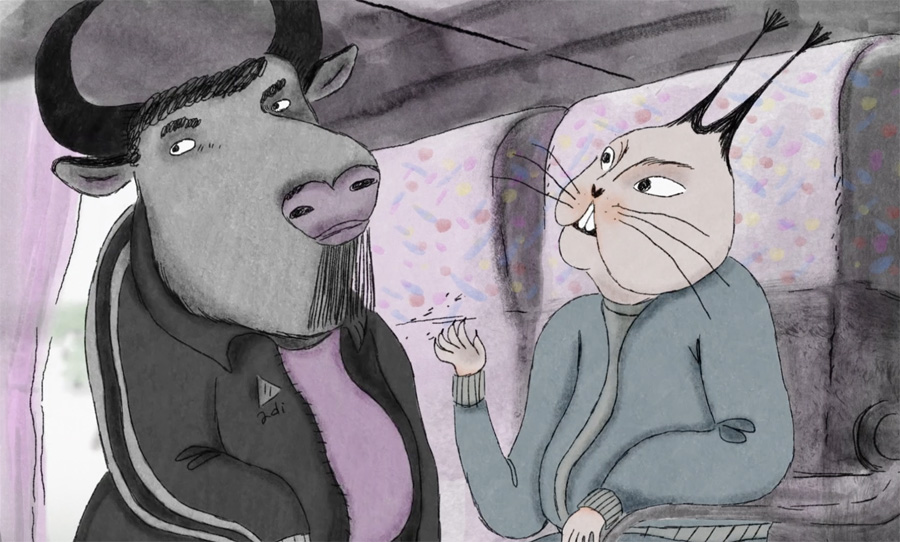
SS: By using animal appearances to describe the passengers, I wanted to help myself tell a story that was very close to me, while keeping the necessary distance. I was afraid of falling into clichés or human caricature by exaggerating emotions, and I didn’t want to portray the people I encountered during my many trips between the two countries as caricatures. Anthropomorphism offered me that freedom. Agata comes from a very green region, rich in forests, in the northeast of Poland, near the Belarusian border. It felt natural that she would carry with her the imagination of her childhood, nourished by the stories she was told. The animals she imagines really exist in that region, and children’s tales there are often populated with them. This connection to animals also interested me in a broader sense: borders are imposed on all living beings, in the widest sense. It’s only a small nod in the film, but I liked that idea. Agata sees the world through a child’s eyes, and using animal figures allowed me to enter more easily into the realm of the initiatory tale and to use its codes. We quickly grow attached to animals: they become both extraordinary and vulnerable, sometimes even heroic, as in a child’s imagination linked to nature and the beauty of the living world.
JM: What were your goals with the tone and topics of the conversations Agata has with the adults?
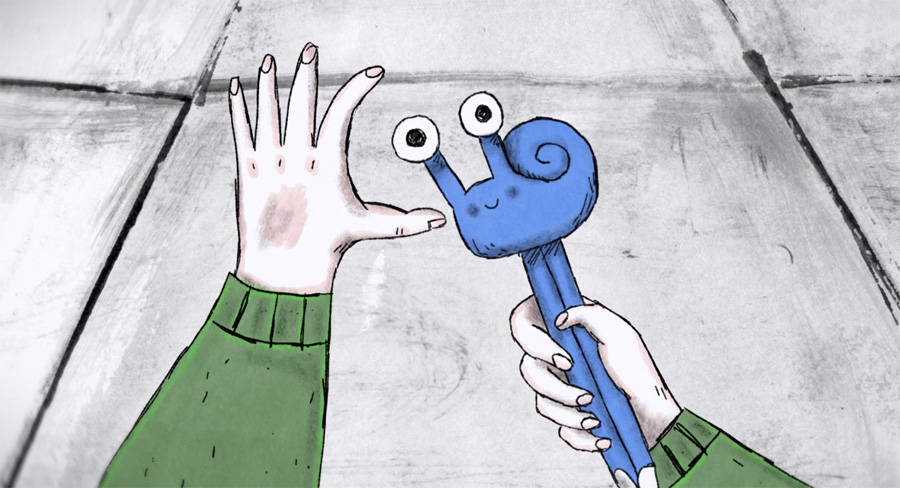
SS: I wanted to feel the contrast between their initial concerns, but once the film was finished, I realized that they had all lost something. The bat-woman no longer sees her son because she works abroad; she sends him material things to “make up” for the lost time. The bear has lost his wife, she left him, and he is traveling alone for work. Little Agata, for her part, loses the pencil she received from her father, which is much more than just a pencil. The sparrow-lady is far from her grandchildren and her family, and carries a deep melancholy. Through their stories, Agata encounters the losses experienced by these adults and, in a way, accepts that loss is part of life. She learns to navigate it. What can one take from home, if not the stories people tell each other, the stories that shape our roots when we migrate?
JM: How was it crafting the quest for the blue snail pencil, including larger than life sequences?
SS: For the scenes under the seat, where Agata slips through in search of her pencil, I loved collaborating with Noémie Marsily, who fully embraced my universe while adding so much of her own in the creation of the sets. She was very attentive to my needs for this sequence, and the sets contributed enormously to the atmosphere. When Agata passes behind the jars of brine and her image becomes distorted, I also wanted to tell a story of self‐discovery. Our contours sometimes blur during the immigration process. We don’t always know who we are anymore, and that’s when memories resurface, like the one of her father fishing by the river. Agata is tiny, extremely small, to visually express this feeling of loss, wandering, and searching for oneself. And through the blue pencil, it becomes a quest for communication, for connection with her loved ones. How do you stay connected despite loss, despite hardship? That is what I wanted to explore above all.
JM: How did you want to present the theme of family in your short?
SS: I wanted to show it realistically. Not as something perfect, but as something difficult to build. Despite the distance, one can make the effort to maintain a bond, it’s hard, but possible, even if only a little. I wanted children from “imperfect” families to recognize themselves in my film: single‐parent families, separated families, families shaped by immigration, etc. As a child, I would have loved to see that in an animated film.
JM: How do you believe in the power of drawing and imagination?
SS: I believe imagination is an endless force. With it, we can get through very difficult moments, because it allows us to find beauty everywhere, even in the heart of hardship. It helps us reconnect with ourselves when the link is fragile, and to connect with others in a subjective way. It reminds us that we are sensitive beings, it humanizes us. In Agata’s case, she is not only searching for a blue pencil, but for her lost communication with her loved ones. She must go through inner trials to find it again, just as we make efforts to stay connected. Her pencil also gives her strength: it gives her a power, the power to connect to reality in a personal way and to share her story with the world. I wanted the viewer, at the end of the film, to feel the desire to create something themselves. To tell something from the inside.
JM: What would an Oscar nomination for “Autokar” mean to you?
SS: It would be an immense honor for the film we created, with a team of wonderful, deeply human, and very talented people, to be recognized in this way. And, to be honest, a great surprise: I never imagined this film would find its place on the shortlist. My grandparents, during the communist era in Poland, worked for several years in the United States, far from their children, my parents. This recognition would also be for them, for the efforts they made to give me the possibility of being where I am today.