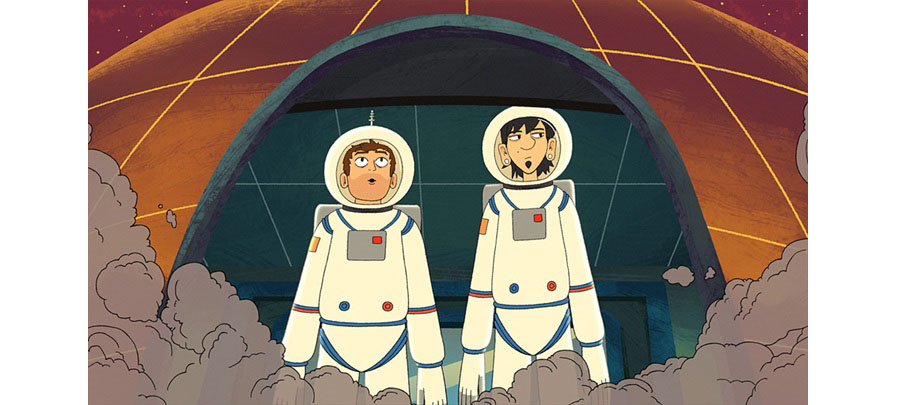
Mickey Mouse is an cartoon character co-created in 1928 by Walt Disney and Ub Iwerks.










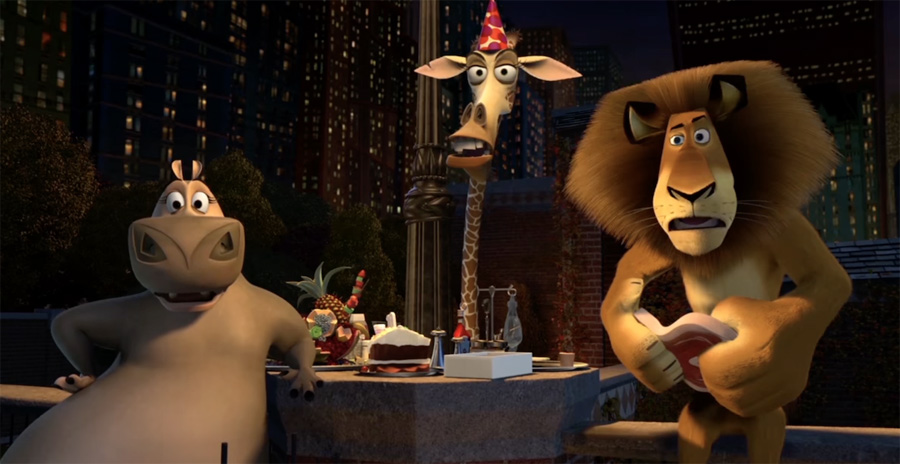
DreamWorks’ Madagascar returns to theaters nationwide starting Friday Jan. 16 for a 20th Anniversary re-release. Directors Tom McGrath and Eric Darnell reflect on making the star-studded comedy classic, which spawned two sequels, a Penguins spinoff film, TV shows and holiday specials. And is a new installment is on the way? (This Animation Scoop Q&A was edited for length and clarity.)
Jackson Murphy: Tom, I remember going to the theater and just being blown away by the way you depicted New York City landmarks… the Central Park Zoo and the Grand Central Terminal so accurately.
Tom McGrath: New York’s such a unique city, and Eric had lived there. I was born there, but at times we would go record Ben Stiller and Chris Rock and some of the other actors in New York. And Eric and I took a video camera and actually walked where Marty the Zebra went from the zoo all the way to Grand Central Station, just to capture as much of the essence of New York has, and Kendal Cronkhite, who was the production designer, really was detail oriented. Even though we were abstracting the city and caricaturing it, we really wanted to capture the essence of the city.
JM: You did such a great job with it. I’m thrilled that it’s back in theaters for its 20th anniversary. Eric, when the movie opened May 27th, 2005, it was the same day as another Chris Rock movie, “The Longest Yard”. “Madagascar”, its second weekend, rose to the number one spot. Do you remember looking at the box office results, seeing how it was doing in theaters on those first few weekends?
Eric Darnell: Yeah. You always do that. The folks, in the business side of things can look at the first hour of release and go, “Okay, pretty much we know everything.” So you get a lot of answers right away. But it was just a thrill to see it do so well, frankly ’cause you pour your heart and soul into something for five years or so. This is kind of the coming out party. You can’t do it for the release day because it’s hard… it’s like getting a college degree. The time you spend and how well you get to know this world and these characters and everything. You have to do it for the day to day love of animation and creating stuff and working with all these amazing artists. But it’s nice to get that payoff. At the end of the day to go, “It was worthwhile not just for me, but for other people and to touch so many lives.” And also, I think for whatever reason the “Madagascar” world resonated all around the world, really big in… countries across the globe. And so that was really satisfying too for us. I think that we could connect with people from all different places and cultures and backgrounds,
TM: It’s not the destination, it’s the journey. And even though it’s 20 years since the movie came out, Eric and I are celebrating our 25th anniversary of when we started the thing and watched Erics kids grow up through it. We spent 15 years pretty much together working on all the movies, which is a great celebration that it’s still around and people are still thinking about it.
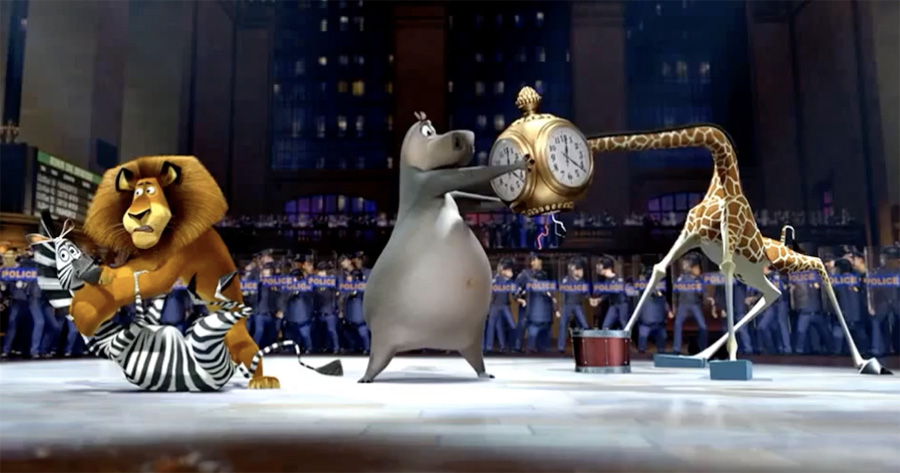
JM: “I like to move it. Move it” was such a phenomenon in 2005. Tom, when you go into making a movie like this… I think nowadays maybe people are like, “Oh, maybe this will become the social media thing. This’ll become the phenomenon.” Did you have any idea that “I like to move It” was gonna have as big of an impact as it did?
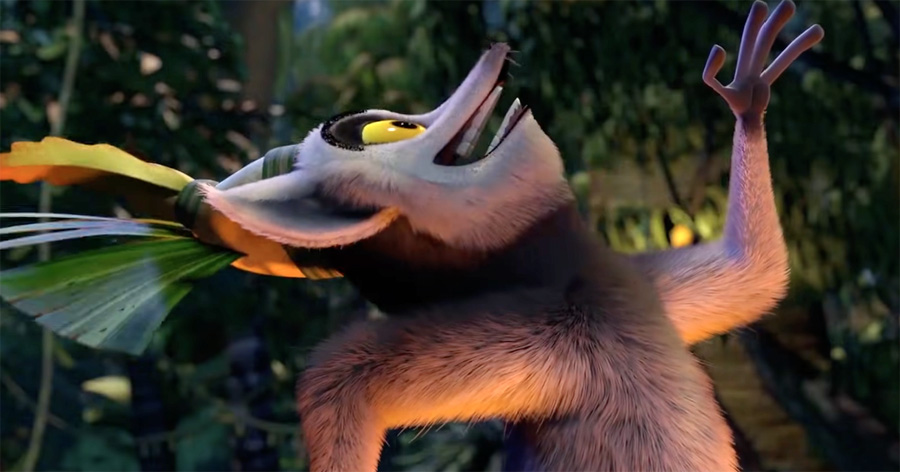
TM: We didn’t. Actually the song was put in by our editor at the time Clare de Chenu [now Claire Knight] and she threw the song in ’cause we were thinking of the lemurs as being loungy hipster partiers. And then when we got Sacha Baron Cohen… he rose from a character having two lines to then becoming the king of the island because he was so funny. And he was more than game to sing the song, He killed it because he just made it so fun and funny.
ED: In one of the screenings, before we released the film, we had “Move It” in. At the end of the film the song comes back for the credits, and some kids in the audience jumped up and started dancing and Tom and I looked at each other go, “Hey, I think it’s working.”
JM: That’s great. It did very well. It was the biggest animated film of the year. And I think Eric, one of the reasons is because of the energy. It’s electric. These characters are bouncing at the screen in many cases. What do you love about the energy of the film with these characters and their dynamic?
ED: That was certainly by design. Tom and I are both like big fans of the classic seven minute, Warner Brothers cartoons and how broad they went with the animation and how the jokes just keep coming and the slapstick. We hadn’t seen anything like that really done with computer generated animation before, and so we really wanted to see how far we could take that. Yeah, it’s really energized. Things are really snappy. Characters slam into a really strong pose and hold it and then slam into another pose and hold it. We really worked with the amazing team of character designers and technical directors to allow our characters to have all that push and pull and squash and stretch and everything to try to get that look and that energy that you described.
TM: They had to write a lot of computer code to allow us to stretch the characters around ’cause it hadn’t been done it. Now it’s commonplace.
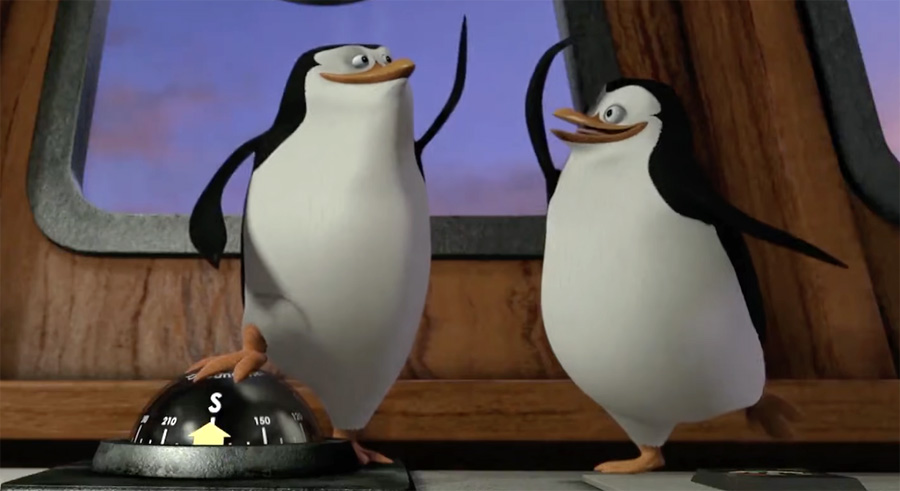
JM: We have to talk about the Penguins. Tom, you had the holiday short come out with “Wallace & Gromit [The Curse of the Were-Rabbit]” later that year of 2005. The TV series started on Nickelodeon a couple years later. The Penguins just created this style — this energy and this vibe that audiences of all ages just really liked… their attitude, their swagger, everything about them. Do you remember some of the initial audience reactions to the Penguins, and how quickly did you get going on some of those other projects?
TM: Penguins weren’t originally in the script. Eric and I invented them as we went along. They are these little side characters. In fact, the studio at the time was going, “Why are these penguins in the movie?” They just had a scene where they just turned the boat around and the crates fell out, which I had storyboarded at one time. Eric and I wanted an old actor like Robert Stack to play it ’cause we wanted characters that played against type — these big characters in these little bodies. And so Eric and I were determined to keep the Penguins in the movie. So they became the inciting incident of inspiring Marty to leave the zoo. We had ’em come back later in the film, so we were embedding them into the story. So there’s no way we could cut ’em out of the movie.
ED: We did have this storm at sea that knocked the crates off. But we had both come from other films that got cancelled… not for our faults… but that had penguins in them. And Tom said, “We’re gonna get penguins in this movie somehow.” And then one day he came to work with all these little chicken scratches and he had these characters. We had no penguin characters in the movie. We had nothing. And he came in with these storyboards. He goes, “What do you think?” And he had all the characters worked out. And Tom came up with this wonderful idea that really, I think, took the whole movie to another level. And there was one point where we were having so much fun with the penguins that Jeffrey Katzenberg said, “What are you doing with these penguins? Take them out!” And we did. And after we did and had another screening the other execs said, “What happened to the penguins? They were so great.” And so then in our meeting with Katzenberg, he goes, “Well these penguins are working out pretty good. So put ’em back in.”

JM: How quickly after the first movie came out and did so well did the studio say, “Go make another one and then go make another one and go make a spinoff and go make the holiday special”?
TM: I think at our cast and crew party, Jeffrey wouldn’t let us watch the movie ’cause he wanted us to start thinking about a sequel. So we were already brainstorming, and this is an era where sequels weren’t really around. “Toy Story 2” kinda launched that. All of a sudden sequels became kind of part of everyone’s awareness. I think at the premiere we were working and doing a pitch on the next [one]. They were gonna go to Africa. We knew that.
ED: And even when we did this great African trip, 10 days or something… every chance he got, Jeffrey Katzenberg would say, “Tom and Eric, those guys are all gonna go out and take pictures of animals today, but we’re gonna hang around at the hotel and continue to develop the next Madagascar.”
TM: And then the studio wanted a Penguins script. So Eric and I wrote a Penguins script for a movie. And it was kinda out there. It was really crazy. It was really fun. But at the time, they weren’t sure that a spinoff was right. They wanted more of the main characters. And so I think that eventually kind of evolved into the TV series.
JM: Not every animated movie gets the opportunity to come back to theaters after 20 years. What does it mean to you to have your movie come back to the big screen for this new generation?
TM: When you spend so many years on a film, you hope it has a life. In your life and your career, you wanna leave something behind, and something that lasts is really a joy to have. I’m really interested in going to see it because for us comedies are very communal. It’s a shared experience. And at the time, there weren’t high back chair theaters, and it was actually put out on film. The great reward for us after three or four or five years of working on it is sitting with an audience and hearing the laughter and having a shared experience. And I hope that the rerelease brings that back to cinemas where people can laugh together. Laughter’s infectious.
ED: When you work on something like this, you get so granular. You’re talking about frames here and just all of this detail. And when you go into a theater and watch it for the first time with an audience, even then it’s almost like a scientific study. “Okay, they laughed there. Great. Okay. Oh good. That job worked.” It’s nice to have a little bit of a distance from the making of the film to be able to sit in an audience that some of which hopefully… will be watching it for the first time. And this time I’ll be able to enjoy it a little bit more like an audience member myself, because I have that distance. And so I’m just really looking forward to having an experience with the audience rather than one where I’m like studying them.
TM: Jackson… there are a lot of people your age who are now parents, and now they’re bringing their kids to it. So it’s kinda cool that there’s a continuation generation.
JM: DreamWorks Animation movies were distributed by DreamWorks. They went to Paramount. They went to Fox. They’re now Universal. I think the question everybody wants to know… the fans of the franchise…. Is there more on the way?
TM: There could be. I think the great thing about Universal and DreamWorks right now is they know that they could make money on a “Madagascar 4”. But the question I think that the studio has, that they’ll always have is… “Is there a good story for a fourth one?” And it has to be a worthy story to make the sequel, so it’s not necessarily a money grab. Eric and I love those characters, and there’s plenty of life to be had. It’s just finding the right story to tell in the franchise.
JM: Ok. So are you thinking about a story? Is it always in your head?
TM: Eric and I are both on other projects right now, but in my heart of hearts, I would love to get back together.
ED: We do have ideas. We’ll just see. We’ll see… how the cards fall.