Mickey Mouse is an cartoon character co-created in 1928 by Walt Disney and Ub Iwerks.














Stop-motion The Girl Who Cried Pearls, from Academy Award nominated directors Chris Lavis and Maciek Szczerbowski (Madame Tutli-Putli) is one of the 15 finalists for the upcoming Best Animated Short Film Oscar. This drama is the story of a girl who has a major impact on a boy’s life… told from a unique perspective. (This Animation Scoop Interview with Lavis and Szczerbowski was conducted as an Email Q&A and was edited for length and clarity. Images Courtesy: The National Film Board of Canada.)
Q: What was important to you about using the framework of a grandfather telling this story to his granddaughter?
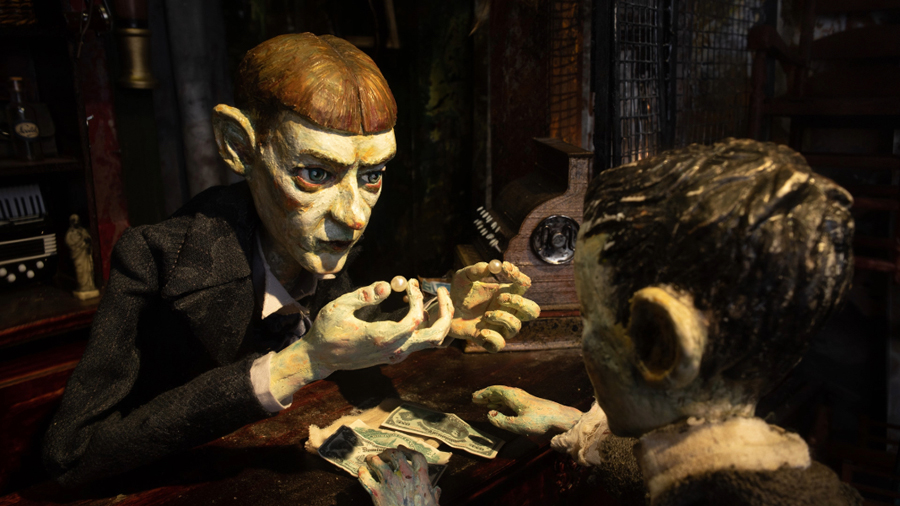
A: The film’s structure is pretty classic, almost like a short story you’d read in high school. That was the challenge, to not slip into the cozy sweater of surrealism that defined our previous work, but to tell a story from A to B to C. “The Girl Who Cried Pearls” is about a fortune built from a crime—maybe most great fortunes are. An old man catches his granddaughter stealing something from his office, and he’s inspired to confess his darkest secret to her. After all these years, he’s finally ready to tell his story. As we imagined it, the grandfather sees something of his younger self in his granddaughter—It takes a thief to know a thief! But then, of course, can you trust a thief to tell the truth?
Q: Colm Feore’s narration is very compelling. How was it working with him and crafting his complex narration?
A: Colm Feore is a Canadian treasure, a first class actor whose work we’ve admired since he starred in the film “Thirty Two Short Stories About Glenn Gould”. Since then he’s gone to play everything from Loki’s dad in the Marvel Universe to Richard III on stage at Stratford. As you say, the grandfather is a complex role, he has to embody a number of characters, including his younger self, without being too theatrical about it—the performance has to stay grounded. Within five minutes of working with Colm we discovered something that should have been obvious: Great actors make your script sing. He came prepared, and added timbre and depth to every word. And we needed him; this film is wall to wall narration, a second class actor would have sunk the ship.
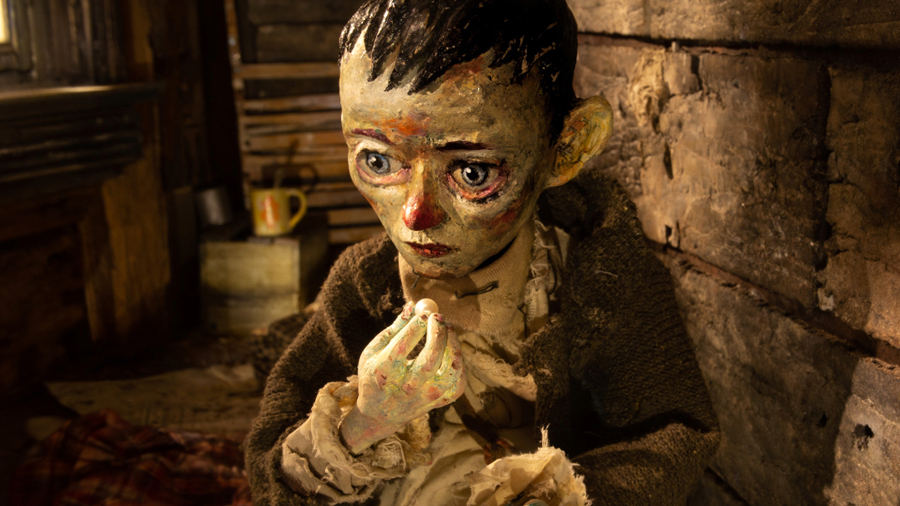
Q: The set design and stop-motion animation are very intricate. What was most challenging about bringing these characters to life?
A: It may not be obvious to those not in the stop-mo business, but puppets are not naturally inclined to come alive. They much prefer to lie on their backs. Everything was a challenge—the wrists break, the hips break, the necks break, the paint wears off. Making the little buggers walk, run, emote, and pick things up is a constant battle against their nature. Adding to that, we made this film during the pandemic, which meant taking constant breaks while one team member or another went down with Covid. Then there were supply chain issues. Every miniature maker has preferred materials. We like Dollar Store foam core, for just about everything, and Dollar Store crazy glue, nothing acts faster or holds so well. Both were tough to get during Covid, and we lived in constant fear they would run out.
Q: One of my favorite aspects is the lighting. It’s significant both in daytime and nighttime, especially watching the girl crying. What work went into creating the great lighting?
A: In the old days, the first decade of the new millennium, we’d get sunburns from standing under tungsten lamps for twelve hours a day. Our camera moved by muscles and instinct, using yard-stick increments and protractor marks. On this film, we finally embraced LEDS and motion control rigs. We couldn’t have done it without the National Film Board of Canada’s technical team, namely Yannick Grandmont and Eric Pouliot. Yannick was an enormous help with the lighting, often he would do the first pass at a set after we’d discussed our intentions. Then together we’d tweak it, adding spots, mirrors, and gobos, playing with gels and colour temperature, until we were satisfied. Both Eric and Yannick programmed the motion control camera, the movement based on our live-action animatic. Eric also programmed LED lights on set, creating in-camera effects like fireplace flicker and the magic “pulsing pearl” lighting that appears whenever the girl is crying. Yannick and Eric weren’t supposed to spend as much time on-set with us as they did, but they got caught up in the challenge. In stop-motion every shot presents a unique problem, you get addicted to solving them.
Q: This is an emotional saga, with several themes and life lessons that really shine. What do you love the most about what “The Girl Who Cried Pearls” has to say about life and love?
A: That you found the film an emotional saga is incredibly gratifying. That’s the goal and after that, who cares what we think? Who are we to say what it’s about, once the film is out in the world? That said, our initial impulse was to tell a story about value and belief and the astounding power of art and storytelling to create both. A stop-motion filmmaker creates life out of dead material, but we aren’t Promethean, we’re hucksters, side-show tricksters selling a twenty four frames a second illusion, literally made from cardboard. We believe in it because we need to believe in magic and romantic love, because the alternative is too awful—a universe that’s as cold and unfeeling as plastic. The grandfather’s last line sums it up for us: “It’s always the story that gives something its value, only the story, never the object…And personally, I still find it beautiful.”
Q: You’ve screened this film, and won awards, at TIFF, Annecy and Ottawa festivals. How has the reception been around the world?
A: It’s been wonderful to finally get to screen the film after so much labour. We’ve been overwhelmed by the amount of thoughtful, emotional responses. Maybe the most interesting reaction has been from those who tell us the movie feels old, like an adaptation of some ancient or forgotten story. That’s your greatest hope with a fable, that people can’t imagine there’s an author involved. Myths and fables should feel like they emerged from the Prime Vibe, the collective muck of the unconscious. The awards feel great, mostly they help justify the enormous trust that our producer, the National Film Board of Canada, and our financier, the Canadian taxpayer, put in us.
Q: You were previously Oscar nominated in 2008 for the animated short “Madame Tutli-Putli”. What do you remember most about that night?
A: Relief that the whole grand, thrilling and occasionally stressful ride was at an end. The moment our category was given out we could just enjoy ourselves. The first ad break after our award, the legendary cinematographer Janusz Kamiński wrapped his bear arms around us and steered us to the bar to get a drink. The rest of the night was the party of all parties: Telling Ethan Coen he inspired us, and him saying “Don’t blame me!” Dwayne Johnson crushing our hands with his grip after we told him we loved “The Rundown”. George Clooney telling us he didn’t expect to win, then laughing when we said “We did!”. Telling Marion Cotillard how amazing she was as Edith Piaf, then admitting we watched it on an airplane. Viggo Mortenson with an Argentinian soccer flag around his shoulders gushing about the greatness of the Montreal Canadians hockey team. We bounced from star to star, hooking anecdotes like fishermen with a stocked pond. You never know if and when you’ll be back in that room and we squeezed it for all it was worth.
Q: What would it mean to you to be Academy Award nominated for “The Girl Who Cried Pearls”?
A: That’s a difficult question. It’s an enormous honour; the Oscars are without peer, the international standard for judging the cinematic arts. But there’s also a certain amount of anxiety. Every filmmaker on that shortlist, representing all fifteen films, is looking at the announcement date with a combination of excitement and trepidation. Five films will be nominated. The rest will not. So it goes. It’s a very solid group, so honestly we’re happy to be in the mix, happier still for our collaborators. We all couldn’t be more proud of this film. After a struggle, it’s exactly the movie we wanted to make.