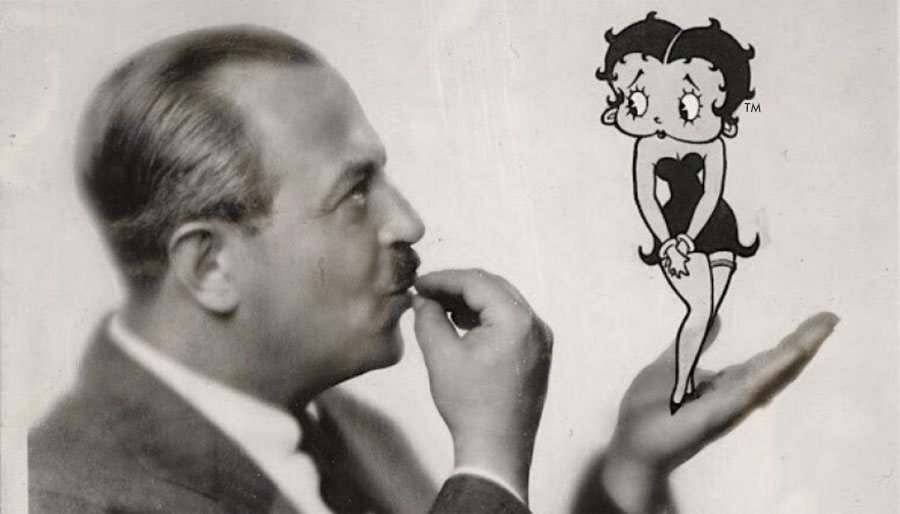
Mickey Mouse is an cartoon character co-created in 1928 by Walt Disney and Ub Iwerks.











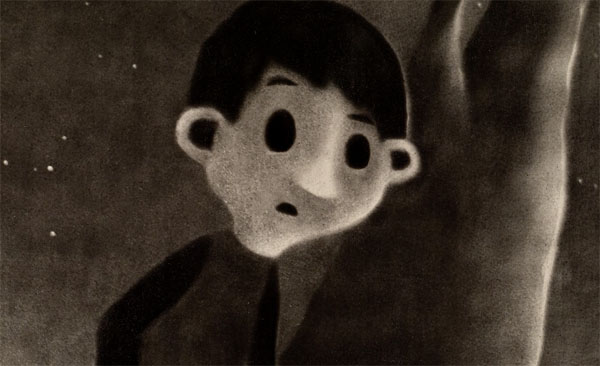
On the 98th Oscars shortlist in the Best Animated Short Film group is The Night Boots, from director Pierre-Luc Granjon. It’s about Eliot, a boy who sneaks-off into the woods during the night and has heartfelt conversations with a special new friend. “The Night Boots” won three awards at this year’s Annecy International Film Festival, including Best Short. (This Animation Scoop Interview with Granjon was conducted as an Email Q&A and was edited for length and clarity.)
Jackson Murphy: The film’s color palette is distinct. What went into creating the look of “The Night Boots”?
Pierre-Luc Granjon: In “The Night Boots”, I wanted to give the forest real depth, and the challenge was to make sure that the film, which takes place during a full-moon night, wouldn’t be too dark or gloomy. That’s where the magic of the Alexeieff/Parker pinscreen comes in—the device on which I made the film. It makes it possible to create images that are both high-contrast and filled with great softness. It’s an incredible instrument, made up of 277,000 pins that cast their shadows onto a structure of tubes. You truly work with shadow and light, and it allows for an extremely subtle and finely detailed result.
JM: How did you want to capture the spirit of a child’s fascination with the forest and nighttime exploration?
PLG: Most of my short films are set in the forest. This comes from the place where I grew up, where the forest was our favorite playground, to my siblings and I. The feeling I had was that I was part of it, and even when night fell, the forest remained familiar to me and never became frightening. My bedroom looked out onto the trees, and if the window was open, all the sounds of the night would reach me, and there was something fascinating about them. In “The Night Boots”, when Eliot goes to the window and the wind comes to brush his face, it feels like a call from the forest, and he cannot resist joining it.
JM: How did you want to present the strong theme of friendship?
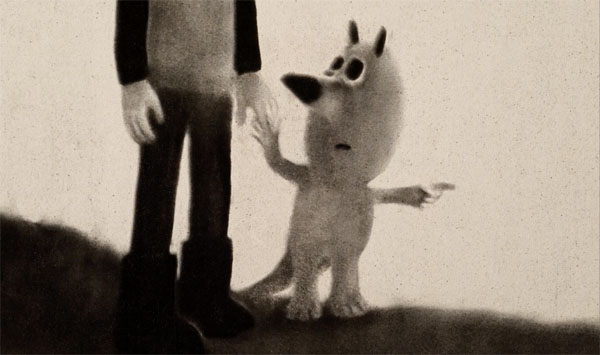
PLG: The theme of a budding friendship is indeed at the heart of the film. I have sometimes met people who seem devoid of shyness, who come up to you and speak as if they already know you. The creature in the film is modeled on this idea: it approaches the child without hesitation, and without all the polite formalities one usually expects when meeting someone for the first time. It takes Eliot a little time to allow himself to be drawn into the forest with this strange little guide, but the journey will be worth it. Staying curious about others, moving toward what we do not know—this is what I wanted to talk about. The media constantly seem to warn us against everything that is foreign and different, and in this particularly dark period, it is instead by accepting and opening ourselves to all our differences that we can hope to move toward a less desperate world.
JM: The pacing is very nice. Were there challenges in how you wanted to structure the story?
PLG: Thank you—there was indeed a real challenge in terms of pacing. Once Eliot leaves the house, the narrative is structured in three parts: the lake, the field with the dead tree, and the burrow. I wanted something quirky and surprising each time, while always keeping in mind that the most important thing was the evolution of the relationship between the child and the creature. I knew that the most spectacular elements would be the forest’s curious inhabitants, but what mattered most were all the small exchanges between Eliot and his new friend: a little paw resting on a boot, the touching way a bed of straw is prepared, exchanged glances, a final gift… all of this forms the true heart of the film. The story involves a great deal of movement, and once again the magic of the pinscreen came into play: one set disappears, another appears, transitions between locations add to the film’s dreamlike quality, and allow me to maintain a precise sense of rhythm.
JM: Eliot’s boots have more meaning than simply being boots. What do they symbolize for you?
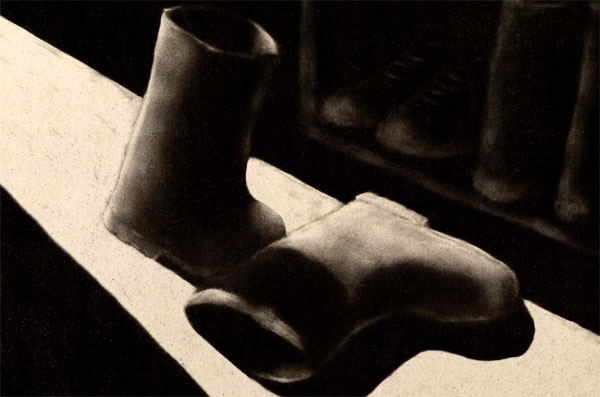
PLG: Indeed, the boots symbolize quite a few things. First and foremost, they are what allow Eliot to leave his home and set off on an adventure—like a key opening a door onto the unknown. They are also one of the first bonds between Eliot and the creature, which cannot resist the urge to try them on. Finally, they become a kind of small consoling gift in response to a question the creature asks the child: “Why don’t I have parents?” They mark the beginning of a friendship.
JM: You co-directed the brilliant animated feature “The Inventor”. So charming and moving. What did you love most about that experience?
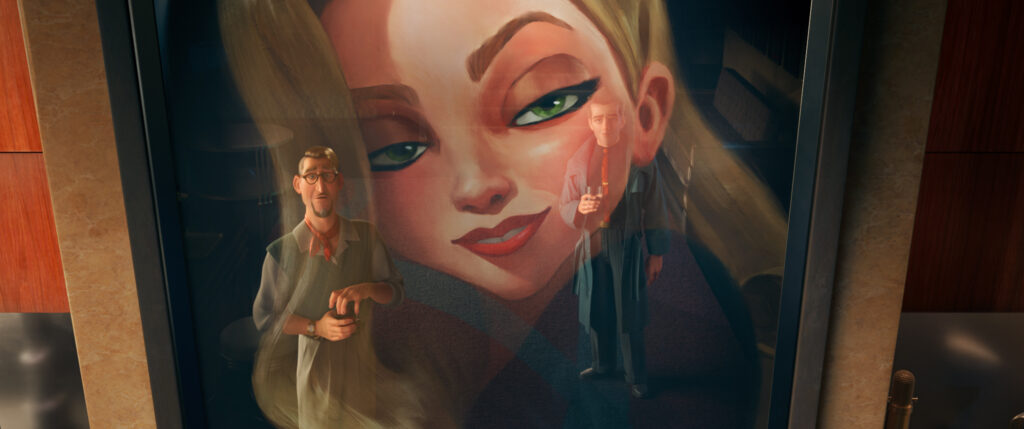
PLG: Thank you once again! “The Inventor” was a long and extraordinary adventure. What stood out most for me was the sense of teamwork: we came from many different countries and were all working together toward the same goal. Meeting Jim Capobianco was also decisive—we quickly realized that we shared the same references in animation filmmaking (including the films of Karel Zeman and Jiří Trnka), and we knew we would get along well. And despite the significant financial stakes of such a project and a tight schedule, the adventure remained joyful and full of life.
JM: What would an Oscar nomination for “The Night Boots” mean to you?
PLG: I admit that I hardly dare to imagine it… But if it were to happen, it would feel somewhat surreal. For Yves Bouveret, my producer, as well as for me, the Oscars belong to another world. A nomination would shine a light on our work, as well as on the pinscreen, which would be wonderful. In animation, we often work in the shadows (after all, I spent a year locked in a very dark room to make “The Night Boots”), far from red carpets. The film’s journey, while delighting us, continues to surprise us, and we let ourselves be carried along in the adventure, much like Eliot following the creature—both hesitant and full of wonder.