Mickey Mouse is an cartoon character co-created in 1928 by Walt Disney and Ub Iwerks.











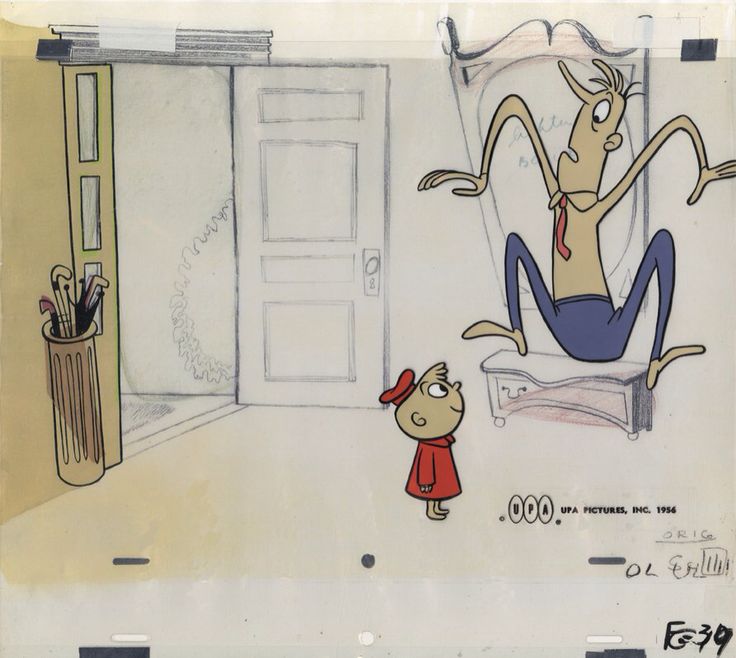
The 1950s produced a cartoon star unlike any other, distinguished by its innovative design, fluid movement, and vibrant use of color. He won an Academy Award in his debut. After only three appearances, he “hosted” his own television show. Yet, by the 1960s, he had made his final cartoon and was consigned to animation histories. Ashtonishingly, Gerald McBoing Boing reached the pinnacle of cartoon stardom only to be forgotten within a few short years.
In 1950, United Productions of America had been in operation for six years when a visitor showed up, a phonograph record in hand, hoping to get a picture produced. That visitor was Theodore Geisel, the inimitable Dr. Seuss. The record was a novelty piece relating the story of Gerald McCloy. The lad didn’t speak a word; he went “Boing!” “Boing!” instead. In typical Dr. Seuss fashion, the story was told in rhyme, with Harold Perry (a.k.a. The Great Gildersleeve) doing the narration.
A receptionist sent Geisel to UPA business manager Ed Gershman, who turned the project down. Geisel left the office in anger and bumped into Studio Head Stephen Bosustow. They knew each other from their Army days, and Bosustow cut a deal with his old friend. UPA purchased the McBoing Boing character and story rights for $500. That sale marked the end of Geisel’s involvement with the project.
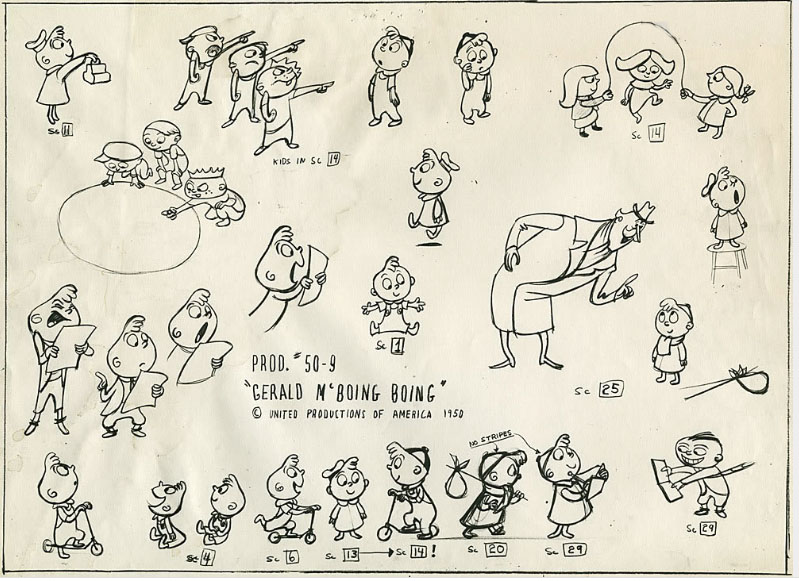
Bosustow turned the project (called Gerald McBoing Boing) over to the team of Bobe (Bob) Cannon, Bill Scott, and Phil Eastman. (Eastman also knew Geisel during WWII and may have even prompted Geisel to approach UPA in the first place). Since the original recording was a poem with incidental sound effects, Eastman and Scott fashioned the work into a cohesive script. Cannon took over as director, an excellent choice, since Cannon disapproved of cartoon slapstick despite once working with Tex Avery and Bob Clampett. Cannon had the exact blend of experience, sensitivity, and aesthetics needed. His best cartoons cast children as protagonists, and no story could have suited him better.
Geisel drew Gerald for the record jacket, but Hurtz, Cannon, and Jules Engel simplified Geisel’s rough, idiosyncratic design, making him cleaner, younger, and smaller. The animation team consisted of Bill Melendez, Rudy Larriva, Pat Matthews, and Willis Pyle. When Cannon and Hurtz decided on the animation style, reductionism became the goal. As Hurtz recalled, “How much could be visually omitted and still tell a story…how few lines could be in this picture? How elemental could it get?”
Very. The McCloy house has neither walls, ceiling, nor floors; a throw rug, a chandelier, and a picture suggest these elements. Since Gerald could not truly speak, Marvin Miller provided narration in rhyming couplets. The background score was composed by Gail Kubik, a freelance composer. Designers Jules Engel and Herb Klynn used primary colors and tints with little regard for the outlines that were supposed to contain them, but color was used most impressively to evoke mood and psychological states. In the scene where Gerald runs away from home, not only is the background dark, shapeless, and threatening, but the character himself turns a dark indigo blue.
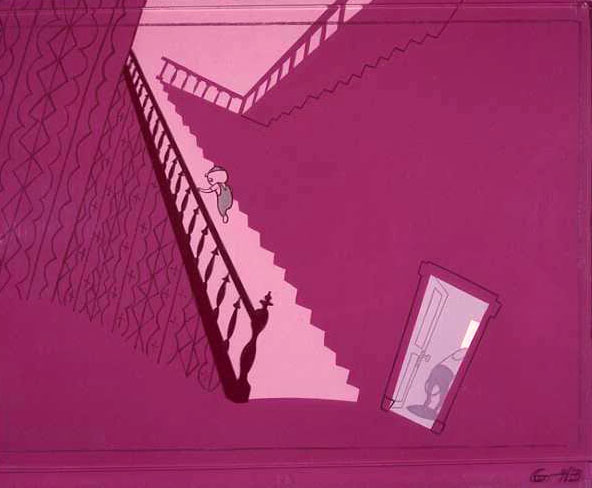
The cartoon opens in the McCloy residence, where Gerald is speaking his first words – or rather boings. The panicked parents send for Dr. Malone, who refuses the case after hearing Gerald. An attempt to send the lad to school ends with an expulsion note. Other children taunt and reject him. Gerald’s increasingly irritated father is shaving one morning when the boy lets loose a jarring blast. Gerald is ordered to his room, where he decides to run away from home for the good of all.
He flees on a dark, snowy night, heading for the railroad and a hobo’s life. Before he can stow away, he is stopped by a monocled gentleman who represents a major radio station; he had actually been searching for Gerald in order to offer him a job as a sound effects specialist. We next see Gerald at the mike on the Silent Sam Steelheart show, where he masterfully pulls off every sound effect in the Old West (this charming sequence was added by Eastman and was not in Geisel’s original story). Gerald becomes a celebrity, riding off with his parents in a stretch limousine, vindicated at last.
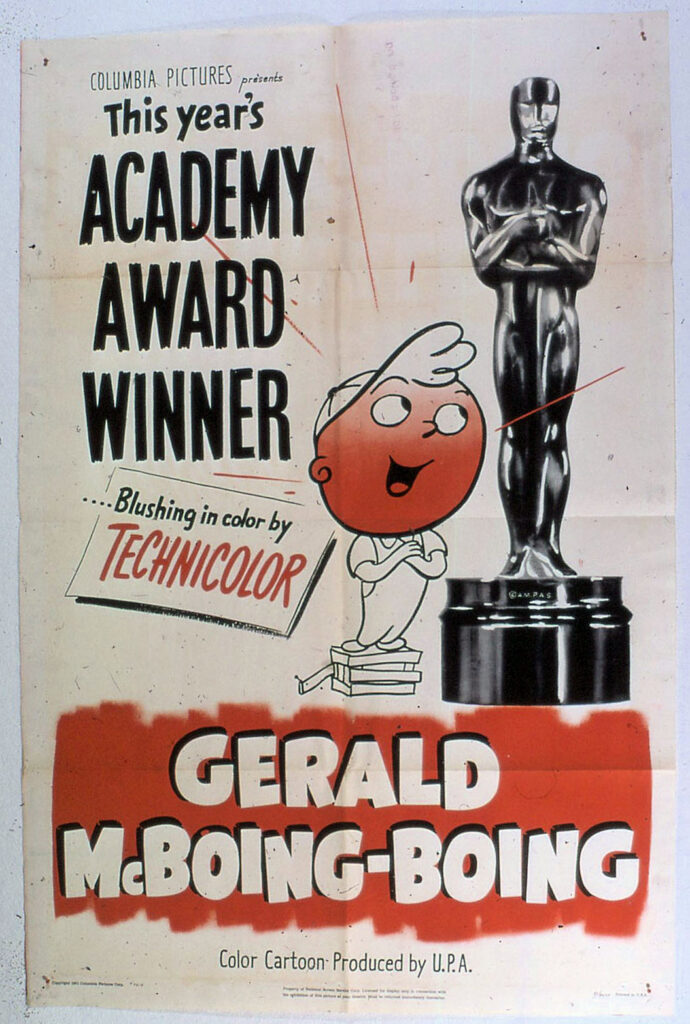
Gerald McBoing Boing premiered on January 25, 1951, and won the Academy Award for Best Animated Short. By 1952, over 25 million people had seen his cartoon. In March of 1952, a second cartoon titled Gerald’s Symphony was announced. It was released on July 15, 1953, as Gerald McBoing-Boing’s Symphony. This short, in many ways, is a superior sequel to the first; a symphony orchestra fails to show up at the radio station where Gerald works, and the desperate manager hands Gerald the score.
Gerald does his best, but inadvertently mixes one of his sound effect scripts with the music. The result is a performance worthy of Spike Jones, and Gerald is fired – until the accolades come pouring in! The character animation is superb, particularly in Gerald’s reaction shot upon seeing the complex orchestral score. The strain on Gerald’s face as he strives to perform the symphony is palpable, and Jules Engel reinforces that impression by having the background change progressively darker from pale orange to deep red as Gerald concentrates.
Unfortunately, this was Gerald’s last outstanding cartoon. A 1954 follow-up, How Now McBoing Boing, is a dull entry based on a poor premise. A speech therapist proposes a cure, but why would Gerald do this since his vocal talents are his livelihood and source of fame? More than a year went by before Gerald’s fourth and final theatrical short, and it was hardly worth the wait. Gerald McBoing Boing on the Planet Moo 2/9/56 had Gerald abducted by aliens so as to provide a tourist attraction for the bankrupt planet. The humor is weak, the intended farce is flat, and the king of Moo comes off as the central character, leaving Gerald as almost incidental. Amazingly, this cartoon garnered an Oscar nomination.
In 1956, CBS contacted UPA, hoping to produce a weekly program featuring the studio’s prestigious shorts. Bosustow contracted for thirteen half-hour shows and named Bob Cannon producer. He decided that the show would need an emcee, and the role went to Gerald McBoing Boing. Cannon soon discovered that UPA was far short of the personnel required for a project of that size; gone by now were Phil Eastman, Bill Hurtz, Bill Melendez, and Bill Scott, along with many others who first put the “boing” into Gerald.
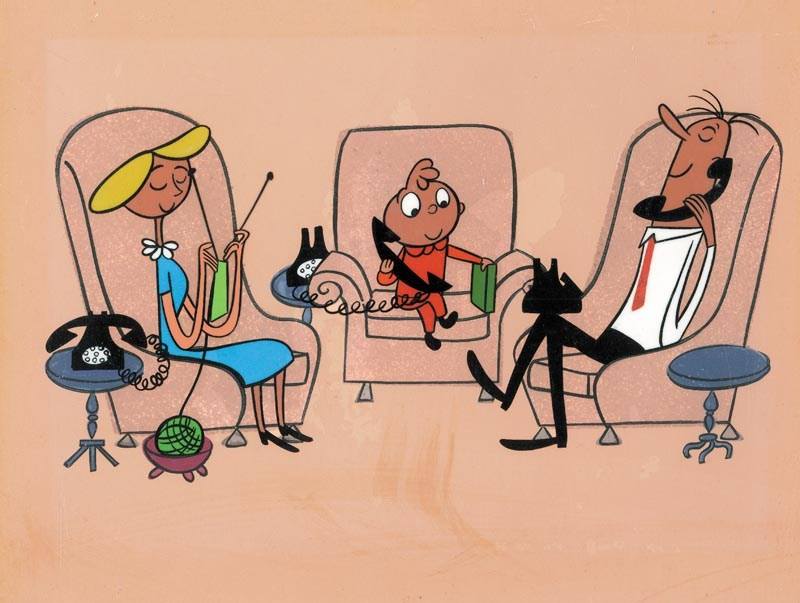
Cannon hired UPA’s “third wave” of talent, including George Dunning, Leo Salkin, Fred Crippen, and Ernest Pintoff. Bill Goodwin was the off-screen interpreter as Gerald introduced each cartoon short. The Gerald McBoing Boing Show premiered on December 16, 1956, and is regarded as the first animated program made directly for a television network. Interestingly, the show had no sponsor. CBS promoted its other shows during breaks.
Despite critical praise, the show was canceled after four months. Reasons may have included UPA’s tendency to downplay comedy in the service of aesthetics, especially as interpreted by Cannon. Cannon called in Bill Scott to punch up the laughs, but this was never UPA’s forte. The program returned as a rerun in 1958 but was blown out of its prime-time slot by October.
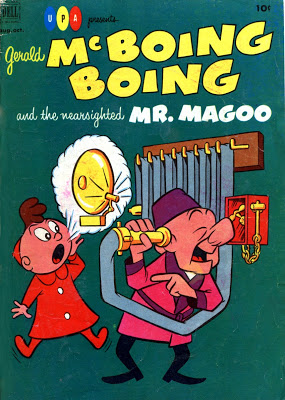
Gerald was later seen in a Mr. Magoo cartoon, “Magoo Meets McBoing Boing,” which was part of a syndicated package of 130 Mr. Magoo shorts released to television during the 1960s. By then, both characters had seen better days. Gerald, however, ended his career with acclaim and honor in the 1962 holiday special “Mr. Magoo’s Christmas Carol,” with a cameo appearance as Tiny Tim. Gerald finally spoke his first words on screen courtesy of voice artist Joan Gardner: “God bless us, every one!”
Gerald never reached lasting stardom largely because UPA was essentially an enclave of talented artists bent on expanding the limits of animated form and design. Gerald was less a character than a triumph of modernism, a novel achievement of the graphic arts. Audiences barely got to know him as a character. Bob Cannon’s role must also be considered; his mild sensibilities doomed Gerald to be swallowed up in the bright, stylish world of his own cartoons. In the hands of a Norm Ferguson or Chuck Jones, masters at infusing personality into mute characters, Gerald might have earned a more lasting place in the pantheon of cartoon stars.
Finally, outside of Mr. Magoo, developing continuing characters was not the norm at UPA. Their most prominent directors preferred to make unique cartoons that stood on their own. At four cartoons, Gerald McBoing Boing was actually one of UPA’s longest-lived characters. Despite this, Gerald McBoing Boing remains a defining moment in the history of animation. The smiling, innocent lad in his red suit and schoolboy cap led a revolution that introduced changes in animation style that continue to influence to this day.
Note: A revival of the character took place from 2005 to 2007 in a series produced by Canadian studio Cookie Jar Entertainment. It was shown on Cartoon Network.
This article is an edited version of the piece that initially appeared in TOON MAGAZINE, Fall 1999.