Mickey Mouse is an cartoon character co-created in 1928 by Walt Disney and Ub Iwerks.











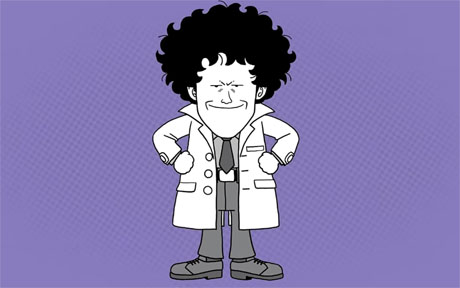
Kazuhiko Torishima spent more than 47 years as an editor at “Shonen Jump,” the most popular manga magazine in Japan. (Its current weekly print run is about 1.3 million copies.) Before becoming editor in chief, he worked closely with three celebrated manga-ka (artists), helping them develop their graphic tales: Masakazu Katsura (“Video Girl Ai”), Koji Inada (“Dragon Quest: The Adventures of Dai”) and the redoubtable Akira Toriyama (“Dr. Slump,” “Dragon Ball”). Toriyama caricatured Torishima as the villainous Dr. Mashirito in “Dr. Slump,” and the nickname stuck.
Although bookstore shelves sag under the weight of all the how-to-draw-manga manuals on the market, Torishima draws on his extensive experience to offer not only instruction, but explanations, anecdotes and cautionary tales.
He stresses the importance of character in a successful manga story. In addition to being likeable, with an immediately recognizable look and catch phrases, a main character needs interesting friends and sidekicks—and worthy opponents or villains—to expand the story. In a detailed discussion of narrative structure, Torishima uses Chapter 29: “A Bad Day at Turtle Rock” to illustrate how “Dragon Ball” shifted from an adventure-fantasy to a battle action manga. This 15-page installment in the blockbuster saga involves only three characters: Goku, Kuririn and Kame-Sen’nin, but each personality is skillfully delineated. Torishima guides the reader’s eye, showing how each panel contributes to both the progress of the story and the visual impact.
Unlike many How-to books, Torishima accompanies his lessons on design and story telling with frank discussions of other problems artists face. Too many books just talk about technical artistic issues; Torishima tackles motivation, burn-out and the cumbersome editing and publishing process. He offers a rare, frank examination of the business of manga: what an artist can expect to earn, what book, merchandise and animation deals can add, and how much it costs to create a manga—equipment, supplies, assistant(s), rent, etc. He illustrates these mundane but vital points with panels from “Bakuman” by Tsugumi Ohba and Takeshi Obata, a realistic account of two high school kids becoming professional manga artists.
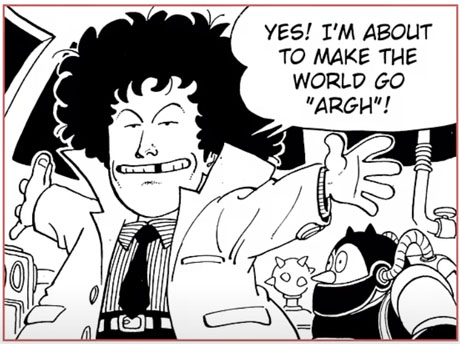
Not surprisingly, Torishima emphasizes the role of the intelligent and sensitive editor in training manga artists, guiding them to reach their full potential. He bemoans the failure of publishers to train and cultivate editorial talent, thereby limiting the company’s profits, the development of future talent and the advancement of manga as an art form. Some readers may find these passages self-serving, but professionals know that a good editor is the best friend a writer can have. (right, boss?)
Although Torishima stresses the importance of clarity in manga page layouts, the book’s one weakness—ironically—is that it’s overproduced. The type is printed in black, blue, orange and white. The pages are cluttered with boxes, footnotes, headlines, subheads, captions, manga panels, caricatures and spot drawings. The material is interesting, but a simpler presentation would communicate more effectively.
This caveat aside, Dr. Mashirito’s Ultimate Manga Techniques belongs in the library not only of aspiring manga artists and graphic novelists, but ”Dragon Ball” fans and anyone interested in manga. Although he officially shifted from full time to free lance work three years ago, Torishima continues to train the next generation of manga artists. The publication of “Ultimate Manga Techniques” brings his advice to aspiring artists across the Pacific.
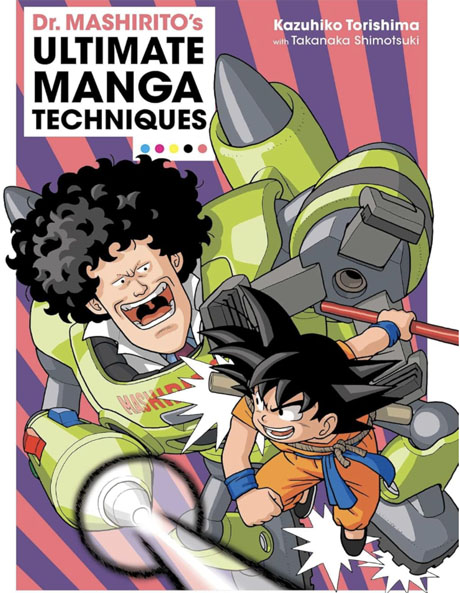
Dr. Mashirito’s Ultimate Manga Techniques
By Kazuhiko Torishima, with Takanaka Shimotsuki
Translated by David Evelyn
Viz: $25.00; 194 pages, paperback